Friday, 15 November 2013

Malacca Malaise

It was a slow day, mainly motoring after a short-lived sail down the Johor Strait from Johor Bahru, the northerly turn up the muddy Malacca Strait was proving to be less enjoyable as the wind was on the nose, if existent at all. After weaving through dozens of anchored cargo vessels and dodging some fish traps and fish nets, we decided to drop anchor at 11pm after the current had changed, and was turning the boat around taking distance off us that was so hard fought. A lightning and thunder storm above us encouraged us to take a quick 5 hour rest before the tide turned again.

We headed off at 4:30am, making for Muar Town the lesser known of the Malacca cities, this one featured two elaborate mosques and importantly our new 15hp outboard motor. Hugh had tirelessly searched for the right 2-stroke outboard in Singapore and Malaysia and had found one at the right price and after speaking with the shop, we were set to pick it up on our way through. Our friends aboard the sailing vessel Atea were kind enough to gift us their hypalon dingy which they did not want anymore as they were upgrading. The dingy was going to be perfect for our needs with a removable hard floor, however the extra weight that it brought also meant that we needed a more gutsy motor than our existing 3.3hp. Our PVC dingy was not surviving the challenges thrown up by the tropical climate and was slowly melting in the sun, losing its glue and generally being less than suitable for our needs (it had been nicknamed by the kids off our friends boat as 'the pool'). So dingy no. 3 (also known as Max - he came pre-named) required a repair job and would enter our lives as our new runabout!

We arrived outside Muar town at 1pm and made the long 3nm dingy ride up the river (impassable by our boat due to the shallow depth at its entry) taking what seemed like an eternity - 45 minutes. We rang the shop that had our outboard and they had a guy in town who would drive us to the store. This was very helpful, as the shop was a 15 minute drive away and there were no taxi's. The town was very tidy and the houses were large and very well presented. It turned out that this was no ordinary place, being the Sultan of Johor's home town and he loved the colour blue - very distinctly painted on most buildings!

The car pulled up at the marine shop and we were shown the outboard by the shop owner - Mrs Sani. It was enormous and we were wondering how we were going to get it back to EJ in our new dingy that still needed its repair job. After much talking, biscuits and water, the deal was made. Hugh was asking Mrs Sani for the name of a nice restaurant in town where we could have dinner. Before we knew it, we were in the car with her and she was taking us to a warung that sold "the best Bakso in Muar" (meatball soup with noodles). We unpacked the motor into the dingy and were escorted to dinner by Mrs Sani and her 10 year old son. It was a great dinner and just what we needed before the long dingy ride back to the boat. Mrs Sani was so kind, after driving us around and then taking us for dinner, what a nice way to buy an outboard! The dingy trip back to EJ was long, but thankfully the wind had died down, so we made it there dry and hoisted the 40kg of motor up onto the boat without too much trouble.

We decided to wait for the favourable tide and slept the night. Expecting to leave at 1am, the tide had not yet turned and the lightning storm was enough encouragement to stay in bed. There was no wind at 4am, so we decided to wait for the northbound tide that afternoon instead. A relaxing morning on the boat and some scones and we were off, sailing this time!

It was 8pm as we sailed past the city of Malacca, meticulously weaving through cargo ships that were coming into port, at anchor and those out in the designated shipping lanes. The wind was still on our nose, but it was blowing up to 15kts which made it quicker going. As the tide turned the wind died out, so we dropped anchor north of Malacca as the lightning lit up the sky overhead.

The alarm boomed at 3am and with wind we were off sailing again. As the morning wore on, the wind picked up pushed by a squall, bringing lightning, thunder and wind. This passed through and we were left with no wind and an opposing tide. The Malacca Strait was turning out to be a tedious affair and we still had 250nm to go to our destination - the Malaysian island of Langkawi.

We made the decision to get more fuel. It was never simple getting fuel and we might not have had enough to get us to Langkawi, and that all depended on the wind. Feeling that there may not be much wind (based on the four previous days) we opted to stop at the Royal Selangor Yacht Club. The club was located down the river past Port Klang - a huge shipping terminal with cargo ships lining the channel. The Club was located in a shallow part of the river which used to be quite remote, though over the last 15 years or so a lot of shipping industry had moved in and the river banks were loaded with warehousing, logistics and fishing trawler boats. The water was filthy, a perpetual tide of rubbish (plastic bags, bottles, styrofoam, wooden pallets and wooden logs) clogged the river, ready to be sucked into the engine water intake or damage the fibreglass if propelled fast enough by the current. We stayed the night to fill with fuel and leave the following day. Thankfully they had a fuel bowser here, the first one we had used since leaving Darwin, as we usually get between 10-20 x 20Lt jerry cans filled with diesel to tediously pour one by one in to the tanks.

48 hours later we made it to the entry channel to the marina where we would be for about a week. The water had cleared up and the brilliant green of the island vegetation contrasted with the aqua water, hopefully a sign of things to come for the picture perfect beaches and water further north. The Malacca Strait is 450nm of challenge, not for the impatient and we were both exhausted after keeping such a vigilant watch out for shipping, fishing obstacles and lightning storms. It was nice to be out of the Strait!


15/11/2013

----------
radio email processed by SailMail
for information see: http://www.sailmail.com

Sunday, 3 November 2013

Singapore - A Planner's Diary

Singapore is in and of itself, a fascinating western enclave in the middle of developed and developing South East Asia. The history of the place and its growth as a self managed Asian centre pre and post colonially makes it a unique and layered society, worth the closer look.

The striking thing about Singapore is the height and density of the buildings. Singapore is a city, a country and an island. This has forced it to be creative and adaptable with its use of land. They have built up (and HIGH!) outwards (land reclamation) and down (building and using the substratum down to 70m currently). Only citizens of Singapore can buy housing, so that also restricts home ownership to its 5.8 million populous, 85% of which live in the Government run Housing Development Board (HDB) units. This affordable housing construction and management authority commenced work in the 1960s driven by the need to house the booming population in the post-colonial/ WWII era. The highest of which is a 7 building complex reaching 50 storeys in height which has a linking public access bridge at level 26 and roof top park at level 50 which include child care centres, parks, food centres, shops, services and child play areas. In the 1980s the HDB also recognised the importance of mixing different income groups in the developments to create a harmonious social mix, an issue which cities across the world are struggling to retrospectively address in social housing developments.

HDB complexes - Queenstown Singapore
The HDB flats are generally a minimum of 20 storeys high. They are narrow buildings so that the unit has two frontages to sunlight and air flow. While the units are tall and there are many of them located in close proximity, it does not feel dense, you can see the sky, feel the breeze and the buildings use brick and masonry construction so the noise abatement is well managed. The buildings have open level common space on the ground floor which allows wind/ air to move under and around the buildings. While the ground floor area has fixed tables and usable spaces, the different times of the day that I visited the buildings these spaces were not in use. Other active ground floor uses such as child care centres and shops are located in the HDB complexes, enlivening the otherwise desolate spaces. The HDB boasts about its continual refurbishment and upgrade program that they run to spruce up the buildings and also upgrade the infrastructure such as install lifts. The units appear functional and there is not a spot of vandalism or dumped rubbish to be found. An amazing contrast to unit developments in any other city (regardless of social or private housing). 

The social and racial mix of the city also creates an interesting set of challenges that the government had to manage. The island was inhabited by the Malay people, had a long history of being a port for transit by the Chinese, followed later by Indian, Dutch, Spanish and Portuguese and finally, the British.

With the mission of securing a trade port for the British, in 1819 Sir Stamford Raffles worked his persuasive powers on the island of Singapore, developing a treaty with the Empire of Johor for protection of the island for British trading exclusivity namely by the East India Company. Decades later his plans for roads, block designs, building layouts and setbacks, footpaths and infrastructure were enacted. Even the 'neat' ethnic districts created to segregate the city are still evident today, though the lines are less formal. Designations were made for Indians, Chinese, colonial (British) and the Malay people. Most significantly for the British though, was the growth of Singapore as one of the world's greatest ports. While the location of such a significant port could have been anywhere toward the south of the Malacca Strait, or even the Indonesian islands of Bintan or Batam, Raffles chose Singapore and it has thrived as an international port ever since. The changing weather systems of the northeast monsoon (wind pattern October - March) to the southwest monsoon (wind pattern April - September) forced 19th century sailing boats to wait in Singapore for the wind system to change, to  continue their sail east or west. This created a convenient location for trading and also re-victualing for further journeys.

1819 Town Plan of Singapore - as per Raffles instructions to his surveyor Lt Jackson
The port city grew from strength to strength and opium was one of the biggest products to be transported through the port. The East India Company is also known as the world's first major drug cartel, producing and distributing opium the world over.

The English language has been used to unite the races on the island city, with 5 or 6 Chinese dialects, Malay, Tamil and Bazaar Malay (Chinese/ Malay mix) being spoken, English was chosen to be the mandatory language in schools. The English language, the English town planning philosophies and adoption of western culture creates an extraordinary place in southeast Asia. That it has retained its western links from the past some 50 years after the British returned ownership of the island to native Singaporeans suggests that the new government thought fondly of their time as a British colony. 

The one thing that Singaporeans can rely on is change. A friend of ours living in Singapore said that he reads the Government proposal about constructing a new road or railway extension and then next day it would have commenced. New MRT (Mass Rapid Transit) railway lines are being extended to the busy western port and upgrade works are constantly being undertaken throughout the city. Common Service Tunnels some 30m wide x 30m high are being included in all construction projects where sewerage, potable water, electricity, telecommunications cabling are collocated for easy maintenance access and economising of space.  The new 'green mark' building classification system is required for all new construction and assessments are undertaken every 3 years after completion for retention of the 'green mark' status of environmental sustainability inclusions (such an energy use, water conservation and waste management). The suburbs are densely packed with HDB and private developments, the streets are tree lined, there are abundant parks and recreation spaces, and shopping malls that service all your needs are at every MRT station. Air conditioned underground interconnected walkways (lined with shops) take you from one place to the next. You barely need to see the light of day or suffer the drenching from the daily monsoonal rains to get your business done.

The Sands - Marina Bay
The 191m high Sands Development - casino, hotel, convention centre, high end retail centre and unit development at Marina Bay is a three building structure with a joining rooftop 'spaceship'. The roof area is a tree filled park/ bar/ viewing platform with infinity pool overlooking the city and is the newest jewel in Singapore's skyline crown. The project was the landmark building on land reclamation work which was commenced in the 1970s. There was public debate about the Sands development, but with a muffled media and closely watched or muted voices of opposition the development went ahead as proposed with little fuss.

So what is the cost for an exemplary public transport system, high level infrastructure provision, network of pedestrian walkways, public housing highly sought after by the Singaporean public and exceptionally clean public domains and waterways?  A densely packed population earning modest and high incomes, close relationships and partnerships with the private sector for construction, maintenance and infrastructure management and the privatisation of essential services. Other income streams come from the famous fines system, where one can be fined for drinking water on the train ($500), chewing gum - $500 (it is not sold in Singapore), jaywalking, or not filling your car with petrol in Singapore before driving over to Malaysia ($500). Not much in Singapore is free, as we found out when we were charged for our serviette with our meal bill.

A fabulous place to visit and probably an interesting place to live. The cleanliness and shininess of the city comes at a price and I fear that that is warmth and high level engagement of the general public in their city and its strategic development. But if you want a train to your door, that is sorted!

3/11/2013

Wednesday, 23 October 2013

00'00'.000N 104'54'.709E


It was so still yesterday that I could hear the sweat beading on my arms before it ran down. The dark clouds built over Pulua Lingga just 100m away and hovered menacing before shirking off to dump their contents on the ocean to the south. At night we were entertained by a lightning storm which lit up the clouds appearing as a shadow pantomime where the lightning (the actor) was shielded from view by a layer of clouds (the screen) and our imagination was left to draw a scene of the gruesomeness of the destruction made by the actors behind the screen. The actors danced away into the distance, nonchalant about the devastation they had left in their path.

We had entered the Intertropical Convergence Zone  (the equatorial trough or more commonly known as the doldrums) the weather was less predictable with rain and wind squalls, lighting storms and wind coming from all sorts of unusual directions or just not at all. This makes for challenging sailing conditions and more patience sometimes than we can summon, which means using the motor to get to an anchorage in daylight.

At 1235hrs on 20/10/2013 as Elizabeth Jane II crossed the equator into the northern hemisphere, King Neptune unleashed his wrath, dumping a torrent of rain and squally winds upon us. We still managed to trim the sails, toast our glasses of rum and take a photo of our GPS as we made our way across the invisible line. And it was indeed invisible as we could not see more than 20m in front of our boat. The rain fell for the best part of an hour and it was incredible to watch the sea become flattened by the falling rain as if it were trying to retreat to shelter.

Disappointingly the wind was on the nose and we were beating to make forward progress, tacking across the equator 3 times, but the first was very exciting as together we entered a new stage in our voyage and Hugh and I officially became shell-backs (a shell-back is an experienced sailor who has crossed the equator). Importantly, we provided a libation for King Neptune with a glass of rum that we donated to him overboard (this was a gift and to provide us with good luck during our travels on the sea).

The evenings celebratory festivities included rum cocktails and spaghetti bolognese (with mince!!!) aboard Solstice with Bill and Olivia. Bill was an old hat at equator crossings, with this being his third. Once again we were reminded that much of the fun of cruising is enjoying special events with good friends!

23/10/2013

Monday, 14 October 2013

Things We Have Learnt About Indonesia


  • Everything must be amplified and once it is amplified, must be at full volume. There is no such thing as too loud, if it is not distorting it should be turned up.
  • In Indonesia, people think the radio will travel further when they shout into it. This also goes for microphones.
  • Cassava can be in any food, be it sweet, savoury or other. If you are not sure what you are eating, it is probably cassava. It is the favourite lengthener to any dish or dish in its own right.
  • There is no such thing as too much sugar. Even a drink of coke can be enhanced by the addition of more sugar.
  • To goreng something (fry it) is a must for 90% of the menu items. If it is edible (and often if it is not), it can be improved by battering and frying it. One of our favourite dishes did not have a formal name, so our guide told us it was goreng goreng (fried fried). An accurate description, and also quintessential Indonesian while still bearing no information on the ingredients! 
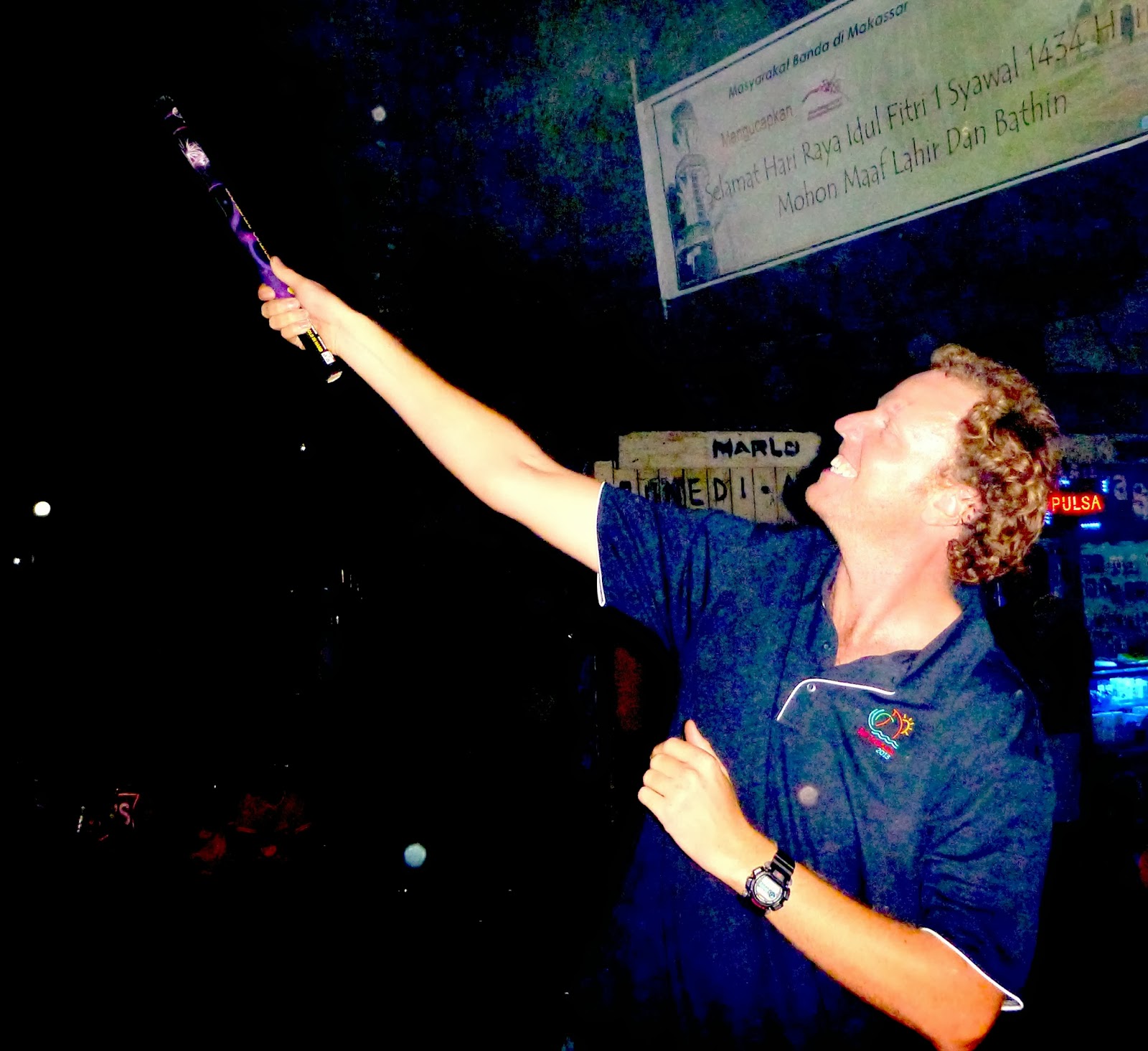
    Fireworks fun
  • Too much fireworks are never enough. We arrived in Indonesia at the end of Ramadan which is celebrated with eating cake and drinking tea and then lighting up the night for the best part of a week with hand held fireworks (which are labelled 'do not hold in hand'). Not one to be left out of the fun, Hugh bought some fireworks and asked some non-English speaking kids to help him use them. They thought it was very amusing when Hugh was holding it the wrong way and asking if he had it right for ignition. Thankfully they corrected him before he lit them!
  • Indonesians loooove to sing and dance, the only thing they enjoy more than doing that themselves, is having you do it with them. Hugh and I became the singing duo of our rally group and deftly performed 'brown eyed girl' and 'somewhere over the rainbow' on the ukulele. I also mastered the jamila line dance and the lulu group dance, much to the adoration of our hosts!
  • There is no 'mix' of businesses that is to obscure. The mobile phone shop where you top up your phone credit is also the LPG seller. The scuba dive shop is also the womens shoe and handbag shop. However the guy who sells the ink for a stamp is different to the guy who sells the stamps. Obviously!
  • Talking about the weather is a mute point. It is always the same as yesterday, 33C blistering sunshine and 75% humidity. 
Indonesian Petrol Station
  • Any motor can be reincarnated to propel a boat, be it a single cylinder, World War II era, diesel engine with a hand starter, two whipper snippers attached precariously to unsupported prop shafts or 8 x 400HP outboards strapped to the back of a passenger vessel carrying people 40nm between islands (that sometimes explode, as our friend experienced).
  • A bloke on the side of the road with Absulute Vodka bottles full of fuel constitutes a petrol station.
  • Our hosts had trouble pronouncing Hugh's name, we learned that the word for shark in Bahasa Indonesian is 'Hiu'. Hugh introduces himself as Hiu wherever we go making the sharks fin on his head, much to the enjoyment of the Indonesians!
  • It's not official unless it's been stamped. At ports and for invitations to events, either our stamp or that of the Government had to be on the paperwork. This was at its most hilarious in Saumlaki (our checking in port) where we didn't have a boat stamp yet and Hugh had to draw a picture on the page as if it were a stamp. This was received with much humour by our hosts, a smile will get you anywhere!
Invitation - stamped of course
  • A smile and some bumbling version of Bahasa Indonesian will almost get you anywhere. I was surprised at how politely the locals applauded our minute comprehension of their language while their English skills far exceeded our Indonesian skills.
  • Navigation lights on Indonesian boats are as much for fun as they are to provide information. Red for port and green for starboard is what we are used to, but red, blue and green flashing lights are par for the course here. Just part of the nighttime sailing adventure!
  • It is an enormous country with a huge population and they are wonderful and welcoming people. An archipelago of some 18,000 islands with a population of around 250 million people are spread through fishing villages, farming communities and enormous cities throughout the country. An excellent place to visit by sailing boat.

14/10/2013

Wednesday, 11 September 2013

Is this War?

You could be mistaken for thinking that, with 25 navy vessels in the harbour (including one from China and one from Singapore), our yachts being searched for bombs, helicopters doing circling routes over the beach and navy officers clogging up the streets, cafes and port. Thankfully no, this was all in preparation for the President of Indonesia's visit to Labuan Bajo, a bustling town which owes its mark on the tourist map to the Komodo dragons and the Komodo National Park just across the bay. So what do the lucky people of Labuan Bajo owe the pleasure of a visit by their very own Susilo Bambang Yudhoyono? A yacht rally whose participants have taken over the restaurants, cafes and the only bakery in town for 10 days as the three routes of the rally converge and continue their journey westward!

We had just spent the best part of a week in the Taka Bonerate National Park, a world class dive site, containing the worlds third largest atoll and some not very inhabited islands. It was a stark contrast to Benteng, our previous city stop, where we had guides walk with us everywhere and haggle at the markets while we tried to save 2c off our carrots. Other excellent features of our time in Benteng was our releasing of a 3 month old baby turtle into the wild (we named him Bruce) who had been protected for conservation by a small village. After this excitement and watching Bruce swim strongly into the big blue, we were taken to a remote village where we went through their welcome ceremony which included some women channelling a village spirit from the past, us being in a water fight with the local kids, all rounded up with a sing along and being swung on a giant swing. The local government officials and the Vice Regent of the island also joined us and they had a blast. All in a days work!

An overnight 150nm sail was marked by Hugh and I seeing a humpback whale for the first time. Gracefully swimming through the water and blowing water high in the air we were enraptured by its enormity being about 10m long. A most awesome sighting! And with that it slapped its tail and dove below! We also had our first night sail with the spinnaker up, sailing for about 16 hours in company with our friends on Hokulea and Kite, we made excellent time in <10kts of breeze. Our arrival at Labuan Bajo was a real introduction into full swing 'tourism dominated' Indonesia. Some people here spoke English, could not give two hoots about having visitors in town and enjoyed the business that we brought to town as we emptied them out of long life milk, beer and cheese. We had been warned by our guides that with the end of the eastern route of the rally, so did the innocence and relative naivety of the townships. We had to haggle for our trips on local transport which was either in a vemo (van that could seat 10 people), an ojek (motorbike) or the flat bed of a cement truck which we ended up catching one night home after dinner. But it has all been fun, and we feel quite spoiled by the hospitality and generosity that has been shown to us by our hosts in the various small towns on the way through.

We decided to leave Labuan Bajo and seek respite in the National Park. We will get as up close and personal as you can get to what are touted to be aggressive dragons. Unfortunately we will be unable to meet the President, but I sent him my regards and hope to have a coffee with him one day soon!

11/9/2013
----------
radio email processed by SailMail
for information see: http://www.sailmail.com

Thursday, 25 July 2013

Kakadu and Darwin

Ubirr sunset
With 10 days to go until our great launch out of Australian waters, Hugh and I took a car to Kakadu for a couple of days to escape the hustle and bustle of boat preparations in Darwin. After walking through the cultural centre and watching the people standing in the water, fishing in Cahills Crossing (not minding the 'beware crocs' sign) we went to Ubirr and peered over the diverse landscape below. We were perched on a huge sandstone rock escarpment that was formed from volcanic action some billion or so years ago, towering above the savannah plain and monsoonal forest below. Our guide told stories of the Aboriginal rock art and the significance of this place to its owners. Whilst sitting in silence to listen to the birds calling each other across the plains we watched the sun set on the horizon sending brilliant colours across the land. It truly was a beautiful place, rich with thousands of years of Aboriginal history. An Aboriginal elder 'Kakadu Man' Bill Neidjie who has passed away now, had great visions for the continuation of the Kakadu stories and culture, he dreams of people from all walks of life and ethnicities telling the stories of this sacred place so that they are not lost in the sands of time. This is one reason why we are lucky enough to be able to come here and experience such an amazing wonder.

Emu roadblock
After spending a night on the Merl campground affectionately known by locals as the mozzie pit, we awoke early and made our way to Nourlangie and climbed up to see the base of another huge rock escarpment. We decided to do a walk to the Gubara rock pools and took the 15km drive on the dirt road. Halfway there we were stopped by an emu who was clearly disinterested in us passing. We managed to get lots of photos of the roadblock and his mates before they sprinted off, with their heads down, bolting into the scrub. After an hour long walk in the hot savannah, it was refreshing to reach the monsoonal forest which provided shade and an abundance of bird and spider wildlife. We were deeply disappointed to reach the mostly stagnant water of the pools and no relaxing swim after our trek was to be had. After some enthusiastic but unrewarding bushbashing and bouldering in search of a waterfall, we trudged on back through the hot savannah to the car (slightly different to the way the Aboriginals would have travelled the land).


Sunbaking

That afternoon we went on a sunset boat cruise through the Yellow Water, the West and South Alligator Rivers. Crocodiles were spotted relaxing on the shore, catching the last of the days sunshine, or patrolling the waters to see if any freebies were to be had from the boat passengers (we were advised to keep our limbs well inside the vessel). We also spotted an amazing array of bird life, with datas, kites, eagles, kingfishers and ducks a-plenty. Another amazing sunset to close our time at Kakadu.


Wangi Falls
Later that week Dad came to visit all the way from wet and cold Sydney. Thankfully Darwin put on a show, and 33C of beaming sunshine greeted him at the airport. At 7am the next morning, Dad and I met Rob our guide for our tour to Litchfield National Park. After the lack of swimming at Kakadu, Litchfield was a welcoming contrast, providing waterfalls and rock pools at every turn. We also got a snap next to some enormous termite mounds and listened to the interesting history of Darwin from our tour guide. The planner in me was very intrigued as to why this city looks so different to all other cities in Australia and why it was so dense in the city centre, with no low level housing to be spotted. The three cyclones and bombing of Darwin had virtually demolished all history of early European settlement, leaving a clean slate for high rise unit blocks to fill the city precinct. 

After a day long tour of swimming holes and lookouts over amazing waterfalls we stopped by at an old tin mine to see the harsh life that the miners here would have lived through with malarial mozzies, searing heat and humidity and the flooding rains of the wet season. The mine closed in 1951 after a particularly wet wet season and now houses bats and snakes, which is a fairly persuasive way to keep people out of the old mine shaft I think.

Dad and I returned to the boat to see the new wind generator installed and functioning and the oven fixed! I should go on holidays more often!

25/7/2013

Saturday, 13 July 2013

600 miles

We left Horn Island with Solstice bright and early, waving goodbye to our new English friends on Bonaire (who we had met in Hamilton and Lizard Islands) who had sailed in late the night before. We rocketed through the Torres Strait, enjoying a joyous 10kt ride thanks to some free 4kts of current (hence the early wake up call). The joy was short lived as we were spat out at the western side of the Strait and right into the Gulf of Carpentaria washing machine. With swell on beam and the boat pitching from side to side, memories of breakfast were not far away. This continued for about 8 hours and the 2 days that we had left to sail seemed like a life term. Fortunately the boat was unaffected by sea sickness and sailed nicely with the 25-30kt breeze right behind us. During my 11pm-2am shift I saw a boat zoom past, assuming it was a fishing boat as I peered at their speed with jealous eyes.

Day 2 came around and Gove was shaping up in my imagination to be the promised land. The pod of dolphins that danced for us at sunset were beautiful, playfully dancing and jumping in the bow wave for about 40 minutes. Together with the cheese and cracker plate and the excitement of the mackerel that Hugh caught it was a lovely evening.

Day 3 and we dropped anchor at 7pm as the sun was setting behind the bauxite conveyor belt next to Gove Harbour. Hello Northern Territory! We set our watches back 30 minutes and enjoyed the late setting sun and ambient evening temperature. To our surprise, Bonaire was anchored up close to shore and returning from having a drink at the sailing club. This was the boat that I had seen while on the graveyard shift, as they rocketed past at 12kts. Having a racer cruiser certainly has its benefits, as they did the same 340 mile passage in less than 2 days! They were pretty smug about it too!

Gove was a red dust town, a regional centre for government services, a bauxite mine and ship loading facility. We visited an Aboriginal art gallery which was in disarray ahead of Kevin Rudd's PM visit to commemorate the 50 year anniversary of the historical and landmark 'bark petition' (and a week after Julia Gillards PM visit and memorial service for the passing of Mandawuy Yunupingu). Two different PMs in 2 weeks! What a hotspot on the map! A trip to Woolworths and we had 'done' Gove.

We left Gove, but it didn't leave us. Rust coloured dust coated the boat as we sailed through 'hole-in-the-wall' (Wessel Islands) and onto Port Essington. The Victorian settlement that time forgot. A settlement that lasted for 11 years (1838-1849) before most of the population died from malaria. An interesting experiment in pioneering that can only be accessed by boat. But one can visit the settlement ruins, pop by the quartermasters store, jetty, hospital and cemetery before wondering why such a desolate location was selected. Needless to say the name Port Essington was aspirational, as no shipping trade continued from this location.

The last push to Darwin was fraught with uncertainty. Tips from sailors ahead of us, guide books, electronic mapping and tide details that conflicted made for some interesting planning. Three Capes to round, another Gulf (Van Diemen) to cross and perhaps the biggest challenge of all was the Northern Territory Department of Fisheries to negotiate with upon our arrival in Darwin. We had to round Cape Don 4.5 hours ahead of high tide in Darwin in order to get a lift off the westward moving current, with up to 10kts rushing through. The Vernon Strait and Vernon Islands complicated the passage with strong current and the anticipation of locks in Darwin certainly got us excited. Darwin experiences 7m tides and the locks had been constructed to make marina and riverbank maintenance simpler.

Rounding Cape Don was great, we got a lift off the current and some new gusts of wind pushed us through the water. As we were sitting back enjoying the ride, we could see some overflows ahead. This is the effect caused by two tidal motions meeting with the appearance of a breaking surf and can sometimes look like a whirlpool as the water swirls and the dominant current takes over. The boat plowed into the overflow, causing 3m waves to crash over the bow of the boat and the bow to bounce through the 3m drop. Thankfully this only happened a handful of times and almost stopped the 10.5kt speed we had with the impact. Fortunately everything was tied down well and nothing was broken down below. The boat crept on and recovered, though the highest speed we have ever done in the boat was history as the current strength lessened and we had to be content with moderate wind speed.

The exciting events were over and we settled in for the final 15 hour sail. We entered the long Clarence Strait at sunrise to meet Darwin, our last Australian stop. The end of our 3 month sail from Sydney and the start of a whole new adventure with new challenges and experiences. Darwin would be our home for 2 weeks before we head for Indonesia and take part in the 'Sail Indonesia Rally' with some 100 other vessels from all over the world.

13/7/2013

----------
radio email processed by SailMail
for information see: http://www.sailmail.com