Tuesday, 15 July 2014

The Wind, It Is Always About the Wind

Our whistle stop tour of the Philippines continues, as we sail east, this time leaving Palawan and making our way to Panay and the northern island tip of Boracay. A beautiful small island that has been completely swallowed up by tourism on steroids. A place that receives 1 million visitors per year and where you can go parasailing, sailing on a small bamboo trimaran, roll down a hill in an inflatable ball or just blitz yourself at the hundred plus beach bars that compete with each others sound system for the loudest venue.

We decided to come to Boracay to wait as typhoon Neoguri blasted its way west, some 200nm north of the Philippines. While we were well out of its path, we certainly experienced heightened monsoon winds and rain, 30kt squalls and sheets of falling rain battered the boat for the best part of 3 days. While I had a cold, I hunkered below as any trip ashore was quite an unattractive option given the big winds and chop that they developed over the sea. On day 3 the sun peeked its head out and we hung out everything to dry and stretched our arms and blinked in the light, deciding to take the dingy on the long expedition to shore. When we arrived there all we found was street after street flooded as we waded through, up to our shins in water. Business and shop owners were vainly pushing water from their premises to the street. Many shops were built at a lower level than the street, so it was a circular process of flood management. We learned later that these types of rains are not uncommon in the wet season, and this flooding happens every week for 5 months of the year. With the low season still seeing thousands of tourists visiting Boracay each week, there was little down time to manage any large infrastructure projects and the governing council did not have the political will to make it happen. Such is the case with so many desperately needed projects in the Philippines, whether it is tax syphoning, lack of political stamina or outright corruption, minor and necessary projects just do not get done. In addition to the flooding, the other obvious issue with the weather (the southwest monsoonal wind and breaking shore) was the erection of 4m high plastic walls on the west facing side of the island by restaurant owners to try and protect their attractiveness with high winds buffeting them for the next 5 months. Instead of sending patrons scurrying for cover when gusts blow bullets of sand into their eyes (and more importantly their cocktails), patrons wander around behind the huge screens looking more like zoo animals. It was a bizarre experience. 

Hugh, the prolific Boracay zoo tourist

With glee we left Boracay and headed south to visit the towns of New Washington and Kalibo managing to sail for half the day with the light winds puffing out about lunchtime. We had been traveling with Will and Trish off SV Shanghaied and we had also befriended an English sailor Andy on his boat SV Shah who had been doddling his way around the Philippines for three years. Andy was playing the role of tour guide for us, and introduced us to his Filipina friend Megs who worked for a charity group that raised funds for cleft palate surgery for Filipino children. She provided some really interesting insight into the challenges that she faces being the logistics manager for that organisation and we had long discussions about the current state of the country. After lunch with Megs and a tour of a mangrove sanctuary we took the long tricycle ride into Kalibo and visited the enormous fresh market. The museum had some interesting facts about how the island of Panay had been settled by Malaysians from Sabah and the anniversary of that arrival in the Philippines is marked with a huge fiesta in January (shame we missed that one!). The center of town was crowded with tricycles and was a busy connection point for people getting off planes and catching the boat to Boracay.

Following the wind we kept on sailing (more like motoring) around Panay and stopping in at the picturesque island of Bantayan, where we anchored just a short 3nm dingy ride from the tourist town of Santa Fe.  

The sun was beating down and showing off all the gorgeous
colours of Santa Fe when we arrived.

We wandered around town, surveying the damage that typhoon Yolanda (Haiyan) had caused in November 2013. A number of businesses were closed (never to reopen) but others had new roofs and walls. The local churches had new roofs or were undergoing complete and detailed renovation. The locals told us that the streets were comparatively bare to this time last year, as many trees were uprooted or their foliage shredded in the storm. After hiring bikes and making our way across the other side of the island we got to see that the inland part was dedicated to agriculture and chicken farming. Along the way we could see the flattened landscape and we visited several communities that were undergoing repair work and were adorned with UNHCR tents and tarpaulins. The locals had a stoic attitude about it all, every year some part of the Philippines is devastated by a natural disaster, it just depends on the location whether the same place will be damaged again. The Filipinos just pick themselves up, dust off and get back to it, such a resilient race amidst such gloom! We also visited a social housing project funded by a mainly European charity – Gawad Kalinga (GK), where dozens of houses were being built in an effort to alleviate poverty for Filipinos. The design was reminiscent of my social housing days and we all talked about how they would fare over time and whether they would become ghettos. Whatever the opinions, the people had a roof over their head and the housing development also included a farming component, so that the residents had something to do and also a way to make money/ feed their families. The most positive aspects of the development were the piped sewer and neat (and safe looking) electricity. The GK employees also talked about the education and training program that they put the budding residents through so that they understood their obligations and responsibilities in the village and home ownership and their contribution of 300 hours sweat equity.

Social housing development which had suffered damage from Yolanda,
proud homeowners give us a tour of their village
Continuing our cross-island odyssey, directly west we found the town of Bantayan a working port with an enormous fresh market (with shredded corrugated iron roofing) still bustling at 7pm on a Sunday night. After having a refreshing beer and watching the sunset, we made our way back across the island to Santa Fe. Upon arrival we found that our dingys were stranded as the spring low tide had exposed the rocky beach for hundreds of meters, we figure 2 hours ought to do it and went to find some dinner. The dingy trip home was not as pleasant as the ride in, as we were battling a rain squall with water bullets stinging our eyes as we searched for protruding reefs that would bring us unstuck. But we made it back, and of course upon arrival at our yachts, the rain stopped and the moon shone through. 


The following day we upped the anchor and to our surprise there was wind! Out comes all the canvas and we are off, making our way around the island of Cebu. There was a tropical storm on the brink of becoming a typhoon that was predicted to track west into the Philippines, so we were keen to find a cyclone hole to put the boat while it passed over. As the day wore on, we realized that we would be parting company with our friends as we made the overnight journey to Surigao, 140nm south and east. We popped the kite and were going along nicely with a light wind of 5-8kts with no seas. We gybed a few times and made our way through the Cebu shipping channel when a squall developed right behind us, as Hugh was struggling to pull the sock down to smother the kite, a 35kt gust ripped through and blasted the kite, shredding it horizontally into two pieces (but leaving Hugh on the boat thankfully). Oh dear. The boat had stopped moving and the pieces of the kite were being retrieved, the squall and its sudden downpour moved off, THANKS! This was not what we were hoping for as we would likely need our spinnaker for the 5 day leg to Palau. Conferences with our friends on the VHF and Andy the tour guide advised us of a great sail maker in Cebu. A change of course and we were headed south to Port Carmen where we would lick our wounds and take the kite the 1 hour tricycle ride into Cebu (the second largest city in the Philippines) to have repairs done. 

At 12:01 am the anchor was down and another day of adventure on the sea was finished. The wind…

15/7/14

Friday, 27 June 2014

El Nido, the Phi Phi Don of the Future?

It seems that everyone is putting their hand up for involvement in the Hollywood movie – ‘The Beach’. While it was filmed on the gorgeous Phi Phi islands of Thailand, El Nido is purported to have been the location for the writing of the book. We went to Phi Phi Don last year and it was a beach that had max-ed out its tourist industry with dozens of boat operators jostling for your custom to drive you to Phi Phi Ley to sit in a ‘secluded’ beach with hundreds of other people. The real drawcard to those islands are the stunning limestone rock formations that rise up out of the water and often enclose golden sandy beachlets that look picture perfect. El Nido has those same limestone formations and is absolutely stunning, without the horrible hectic tourist element. The town has a rough grid street pattern dominated by small shack-like single story shop fronts, the end of the streets at the east of the town has rock wall structures rising to the heavens bounding the town in. Low shrubbery clings to the sharp flat rock faces and gives the town a really enclosed and almost secretive feeling. One morning when it was raining a low band of cloud hovered over the rock peaks and eerily swirled revealing glimpses of the rockscape behind. Bars, restaurants and dive operations line the beachfront and you can stroll along going for a leisurely bar crawl, moving north along the beach to get the best sunset view as the evening rolls in.


Limestone rockfaces enclose El Nido town
We are here in the southwest monsoon which is also the wet season period. Every day, mostly in the afternoon or at night, a ripping breeze pummels the cove and gusts of 40kts send boat owners securing their washing and tying down anything loose.  Next comes the rain, not usually too much but the strong wind drives it into your face and sends you running for cover. So it is the low season for tourism, which suits us just fine. While the daily storm and rain periods are inconvenient, it means that the town is not so busy with tourists.

I made the tricycle trip to the market on Wednesday (the good day apparently). The deafening sound of pigs and goats being led off to the slaughter place (open area behind the market) was my greeting. Bright colours of fresh bananas, avocados, mangoes and oranges filled my eyes. The sight of fruit was exciting as it was not something cherished on Peninsula Malaysia and I made a beeline for the mandarins and oranges. Still the animals were screeching, and pigs can make a good scream if you just look at them funny. At least you know the meat you are buying is fresh, the sound of pigs was a stark contrast to Malaysia, where pork is forbidden. I picked up loads of potatoes, bananas, watermelon, tomato and some replacement ginger for the next batch of ginger beer (more about that later).

As we dropped anchor in the bay, who did we spot but our old friends ‘Shanghaied, Aussies who we had met in Saumlaki on the Indonesia Rally. While we had stayed with the rally for the 3 month period travelling west through Indonesia, they had left at Banda Neira and sailed north to Ambon and onto Raja Ampat, before spending the next 8 months exploring the Philippines. We invited them over to EJII along with some new friends on ‘Free Spirit’ to indulge in some boat brewed hooch - ginger beer. I made up the wort batch in Kota Kinabalu, and it had made the rough passage from Borneo and up the coast of Palawan before its taste testing in El Nido, explosion free which was an excellent outcome! To the surprise of the tasting participants “it was actually ok”, and a few more bottles were opened and shared around. Abe had predicted the brew to be somewhere between downright awful and slightly tolerable, but he was happy to throw down a few glasses!

Boat brew success! Thanks to my tasting team, Shanghaied, Free Spirit and EJII
Another gastronomical (and social) experience was when Hugh and Abe went ashore at Balalo Bay, a tiny fishing village just 40km south of El Nido with no mobile phone reception and one house with electricity (petrol generator). We were hunting for a spot to anchor and dozens of children came running out on the pier, jostling each other and jumping up and down whooping and hollering while waving. They sure were excited to have visitors. With ideas of a fish curry for dinner, the boys went ashore, to be mobbed by all these children. Falling back to our old faithful ‘cross cultural-win’ with children, the high five, Hugh and Abe made themselves very popular with the kids. Hugh is 1.98m tall so when he puts his hands up at his shoulders, they are high off the ground. Filipinos are not a tall race, but the enthusiasm by some kids to high-five Hugh led to much jumping and super-human strength! Such fun kids. 


Enthusiastic High-Fiving!
Eventually Hugh and Abe were able to ask where they could buy fish, and like the pied piper leading the children, they made their way through the village with dozens of kids all pushing to be closest to them, to the man with the fish. Some negotiating done, three small fish were purchased and it was two thumbs up for fish curry for dinner. Abe passed on some exercise books and pens as gifts for the kids, hopefully they will find them useful, and they made their way back to the boat.  It was such a contrast to see this remote village, cut off from other parts of Palawan as there was no serious road access. It was so close to other places that were tourist hot spots, El Nido even has an airport, yet they lived a completely different life. We wondered whether mobile coverage would extend to this location and how long this village would remain in its isolation.


After 6 days at El Nido we decided to move on. We had had a fun time eating ashore, enjoying the edible delights of Adobo (meat stew with potatoes) and diving the beautiful waters. This sure was a nice place to visit and I hope that it does not become as over populated as Phi Phi Don, because that place was real tourism overload! A teary goodbye to Abe-l Seaman Abe (we're not above a cheap pun on this boat), as he left to fly out from Puerto Princessa and we continued our whistle stop tour of the Philippines.

27/6/2014

Friday, 20 June 2014

The Balabac Strait

A crossing that reminded us of the nasty beam swell and uncomfortable seas like the Gulf of Carpentaria and the Arafura Sea. The Balabac Strait bridges the waters between the Sulu and South China Seas, a veritable spin cycle. Abe went to sleep and dreamt that he was in a washing machine with jeans and a belt...the sensation was that close, except without being smacked in the head with a belt buckle. 


Swirling sea, nightime snap off the aft deck
The boat wanted to heel to starboard, but the 3m enthusiastic swell coming at us from the port side was not going to play nice. So began 3 days and 2 nights of an extremely uncomfortable trip making our way from Kudat in northern Borneo to Ulungan Bay on the western side of the Philippine Island of Palawan. You may recall that we were planning a different route east over the top of Borneo, however our plans changed dramatically, but you'll just have to read our next instalment to get the full story on that one.

The southwest monsoon had finally decided to turn up this year, better late than never! It brought a constant 15-20 kt wind and swell with it for the ride. With squalls bringing torrents of rain and 40kt wind gales, we were in for a not so fun passage, though Abe was in for a treat as we 'hove to' waiting one storm out (thankfully it was a short one). 'Hoving to' is a maneuver turning the boat into the wind, dropping the sails and waiting for the storm to pass, some boats have stayed in that position for days at sea waiting for a system to pass through. A break in the rain showed off the stunning and rugged coastline, tall sharp cliff faces with low shrubbery, very different to the jungle clad Borneo coast and lots of steep mountainous terrain. It was with much relief that we turned into Ulungan Bay, so flat and calm that we could finally put the 2 minute noodles away and cook some real food, roasted vegetable pasta it was!

After a good sleep Hugh and I Ieft Abe as boat sitter the next day, and went on the 50km over-island journey to Puerto Princessa (PP), the bustling city of the island and home to some 6000 tricycle cabs (motor bike with a metal buggy and roof structure which could comfortably carry 4 passengers, but could certainly fit 6 judging by the locals!) But first we had to get to town, via the 3 hour jeepney trip. A jeepney's distant cousin was the land rover, maintaining the bonnet and axle design, but with a 30 passenger bench seat capacity thrown in behind the driver and 1 tonne strength roof (for carrying 30kg bags of rice, 30ltr blocks of ice, slabs of soft drink, fuel containers, meat and vegetables). Oh, and adorned with rainbow colours, religious paraphernalia and tinsel, nice! The jeepney driver turned out to be the postman, the payer of bills on behalf of the rural villagers, the corner store delivery guy and the guy who gets your fuel cans filled. He also has a team of able young men carrying all these items up and down from the bus and acting as the reverse sensors with a loud 'tap tap' on the roof of the bus. The trip was long and slow, but it was great to see some of the island hinterland and see how amiably the locals got on with each other, a real community spirit and thoughtfulness.


Bright Jeepneys being loaded up for the homeward bound journey
The town was busy, with tricycle cabs zooming along and squeezing into unsqueezable spots. The immigration office was our first stop, to get our all important 'country arrival' stamp and then down to the customs office to check the boat in. Thankfully our tricycle cab driver was in the know and the drive across town to the far flung offices. The lady at the customs office was great and was helping us learn some Tagalog, she also helped us by identifying which words are the same in Spanish as Tagalog. She spoke almost perfect english and it turns out that three decades of US colonialism is still evident in their education system today and many Filipinos speak excellent english, which is a real bonus for us.

Indulging in some barbequed chicken for lunch (with unlimited rice, as is the selling point here in PP), picking up some donuts for Abe and some more fresh veggies and we were back at the bus station, ready to catch our jeepney home. It had been raining while we were doing our admin chores, but that wasnt cause enough for the driver to lower the front windscreen from its open horizontal position as we sat in the front seat, back on went the sunnies to prevent dirt and insects from lodging themselves in our eyes. Well it was a whirlwind tour of PP with highlights being the immigration and customs office, experiencing a new country and its checking in procedures, travelling by boat is always a different tourist experience. 

20/6/2014


Tuesday, 10 June 2014

Covering off Sabah

Kudat, a strange yet very welcoming place. The former capital of the Borneo state of Sabah, now a town that seems to be lost in another time. Shop houses with timber second stories, footpaths that are used for walking on (not parking scooters or stacking shop wares) and cheery locals that grin at Hugh and shout "hello, hello mister, I love you" before giggling. The man that stopped us in the street to show us the large glass ball that he was holding is his mouth was strange indeed, but funny nonetheless. It seems that tourists from western countries do not visit here much and the locals are stoked to get a chance to practise their English skills.

Kudat main street, neat two-storey shop houses and landscaped median strip
We had spent a few days making our way north after quickly popping in to Kota Kinabalu (KK) - a busy and vibrant tourist town (also the current capital of Sabah). While it is a brilliant city to visit, it is a nightmare of a place to take your boat with no good anchorages in the current south-west monsoon and the single resort marina is slowly becoming more and more member focused, charging an outrageous amount for the simple luxury of using their dingy dock. So it was a quick provisioning stop to top up on cheese and other western delights, some fresh food from the market, oh and collecting our friend Abe who would be joining us for a couple of weeks aboard and we were off again.

On our way out of town, we were busy looking for a fuel barge that we had heard was anchored in the strait between KK and Pulau Gaya. We were following the channel markers and thought we could spot it, but we were not sure so we were asking off the bow of the boat to locals coming past if it was...they just smiled and waved...lost on translation I think. As we were in a precariously shallow part of the channel, we saw it and just came up beside throwing ropes and fenders over the side to secure us in. It was located in a particularly highly trafficked area, but we just had to tie on the best we could and hold on when the wake came crashing through. Seeing the fuel attendant smoking a cigarette next to the 'no open flames' sign, ready to create a floating bomb was just par for the course. The fuel pump was set for super yachts and fishing boats that use hundreds of litres an hour, so Hugh had fun trying to slow the flow for our comparatively meagre tank without sloshing it all overboard, making for another fun refuelling adventure.

All fuelled up we anchored on the northern side of Pulau Gaya, with a picturesque view of the jungle covered hill. There was a small family development nearby who took their canoes out fishing with nets in the evening. We followed their lead, though we had no luck with our fishing attempts, so had to settle for veggie stir fry instead.

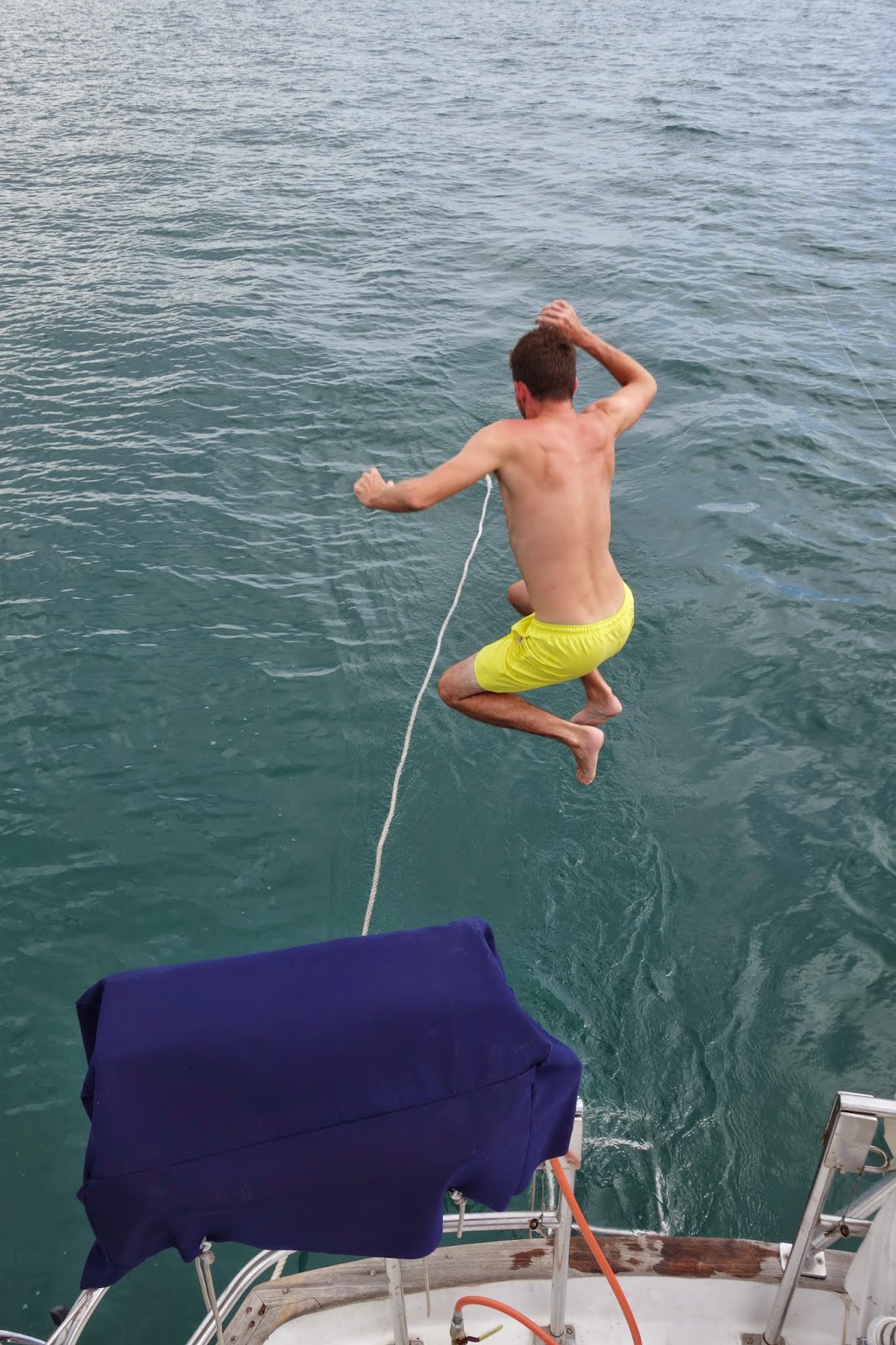
A few days of uneventful sailing and motoring and we arrived in Kudat. Possibly the hottest place we have been to yet, though the afternoon storms do something to quell the searing daytime heat, the subsequent mozzies that come after it are less fun. Diving off the boat for a quick dip while we were underway helped manage our overheating en route. 

Abe taking a refreshing mid-sail swim
Kudat has an interesting history, stories about it being abandoned as the capital of Sabah varied depending on the source with tourist brochures referring to the British relocation of the capital due to the inability to secure a fresh water source, others refer to the repeated sacking of the town by neighbouring Filipinos. The town was then forgotten by authorities and remained remote, with the first road being constructed connecting it to KK in the 1970s enabling the old town to retain its charm and constrained its development or role as a trading port. A brilliant fresh food market makes it a great provisioning port for us. We were treated to some amazing hospitality by the marina managers, who took us out for lunch to gorge on some local Chinese delights and also to the local chamber of commerce to get a 'permission' letter to buy extra fuel (ie, more than 20lts), which made our time here fun and always interesting.


Our hosts - local city Councillor Johnie and his son John
Having seen the main attraction on our way past (the northern most point of Malaysia), we had little else to do here. Impatiently awaiting our package of rope for our furler posted from Australia (which may have been lost in the bowels of the Malaysian postal system) and watching our new 12v to 240v power inverter blow up were just other fun things that remind you why not everyone is out here sailing.


Happy Captain, package success!
10/6/2014

Wednesday, 28 May 2014

Labuan – The Island of Gardens

We arrived on the island of Labuan after a comparatively short and pleasant 3 day and 3 night sail/motor 390nm north from Kuching, we had made it to the northern most state of Malaysia – Sabah. Labuan is famous as the location for the Japanese surrender of the island of Borneo at the end of WWII and is now popular due to its duty free port status. We seem to stumble across these in Malaysia, a tax-free haven where tourists travel here to go crazy buying beer, spirits and chocolate at prices 20% of the remainder of the country. 

Previously owned by the Brunei Sultanate until being ceded to the British in 1846, Labuan is just a stones throw west of its historical owner, though we were not going to visit there this time. The Bruneians do come here to enjoy the free and cheap flowing alcohol and weekender boat trips escalate until quieting down ahead of Monday, as Bruneians make their way back to their oil rich state.

So while Hugh was neck deep in engine maintenance my focus shifted to the small tasks on the boat, planning our provisioning needs upon leaving Malaysia and visiting the beautiful parks and gardens of the island. The number of parks and their immaculate management was such a stark contrast to other parts of the country where nothing but a dust bowl or overgrown patch of land could be found when one was seeking some pubic space refuge. Well tended flower beds, manicured gardens, trees planted to create shady boulevards and colourful paving marked the open space strip which ran for a length of 3 kms through the east side of the town. The inclusion of a meticulously maintained botanical garden is also impressive. 

The strangest part of it all is that the locals just shrug it off, because this is business as usual. To see the locals playing soccer or badminton at the end of the day loving their parks was a great thing to see, or during the day just sitting in their paved plazas’ having a chat, giving the town a vibrant feel. 


A fabulous surprise to experience and an obvious distinction to towns and cities in Peninsula Malaysia. A large income source for Malaysia are drawn from its rich oil deposits mined from the South China Sea. Labuan houses oil refining for easy dispatch via boat, south to Singapore or north to China. The open spaces and parks on Labuan balance out the noxious refining processes that go on here, a dichotomy of land uses.

Other fun features which we came across while wandering through town was the weightlifting ‘strong man’ competition on the weekend and the central market which closes the streets to cars and scooters and bursts to life with fresh cooked food, fresh produce and plants. The music booming from the loudspeakers made me giggle as the song ‘Gangnam Style’ was rewritten to be ‘Sabah Style’. Classy.

We wandered the 3kms east to the Commonwealth WWII War Memorial, which is one of the places where Australian, Indian and British soldiers or POWs who died during the war were buried. We left a flower at Hughs’ family relatives’ plaque, a POW captured with the fall of Malaya. Labuan seemed like an apt place to bury them, as this was the location for the Japanese surrender of this theatre of war. I was leant a book from a fellow cruiser here at the marina on the POW camp at Sandakan in northern Borneo, where 2,424 Australian and British soldiers were worked, starved and marched to death as part of a ‘leave no traces’ Japanese plan. Only 6 men (Australians) survived due to extraordinary escapes and help from local Malay people who were unsure who to trust – the new oppressive ruling Japanese, or the British who were bombing and strafing the land in an attempt to drive out the invaders. Such a tale of a grim 3 year existence of the POWs and their torturous deaths is still today a reminder of the tragic hopelessness of war. 


Commonwealth WWII Memorial, Labuan
The provisioning was another experience, but as usual I had fun at the market. Because Labuan has a mix of Islamic Malaysians, Hindu Indians and Buddhist Chinese, the full range of meats are available you just have to scout them out. Muslims hate pork, Chinese love pork and any meat really, while the Hindus wont touch beef and don’t seem to be that interested in pork. Hugh is feeling a great need for some pork, so as the quartermaster it was my job to solve that crisis. At the fresh market (the pasar) I had to hunt out the pork (babi) seller…I knew they would be hidden in a back ‘sin’ alley somewhere, out of sight and passage of the local Islamic population. So there I stumbled across the babi shack, a small building where the chinese proprietors sold chunks of pork as you order. I ordered with a point and showed how big a piece I wanted and that was that, dinner sorted! Then I wandered through the fresh vegetable market and as usual, the locals were friendly and saying welcome and asking me how I was. I responded with the usual morning greeting and answered their question posed in English with a Malay answer. They always get a kick out of that. It’s easy to get a grin out of the locals, usually by mispronouncing something in Malay or saying good morning instead of good afternoon. 

So Labuan turned out to be another interesting point on our marathon journey through the Malaysian lands, a surprisingly green and recreationally focused town. Next stop, the busy tourist haven of Kota Kinabalu. 

28/5/14

Tuesday, 20 May 2014

Kuching - Cat Bizarre

Borneo, the island known for jungles, Orangutans, Probiscus monkeys and some serious environmental degradation threats. But I am getting ahead of myself...we last left you at the Tioman Islands, lapping up the sunshine and gorgeous aqua water. Trade that for being becalmed in the South China Sea, drifting and hoping against hope that some wind would come around and give us a lift. It never happened. We experienced some squalls which had some very short lived blasts of wind, but nothing to transport us the 400nm east to Kuching, the capital of the southern Malaysian state of Sarawak - Borneo. We even spotted a water spout (in the distance, thankfully) before a 40kt squall blasted through.


Water spout and accompanying squall in the South China Sea
One afternoon we were drifting, approximately two thirds the way to our destination and there was not a breath of wind. The water was so flat we could see our reflections in the glass. Such a strange experience to be in a sea, open to all the elements and there was not a wave nor a tremor on the face of the water. A pod of dolphins came by to say hi, it was one of those special moments and we got some neat snaps of our reflection in the water off the boat.


Reflections in the glass like Sea
So 6 days and 5 long nights after we left Tioman we motored into the grubby Sarawak River and anchored next to the small town of Sajingkat. Excited as we were about getting to land and eating some food off the boat (we had failed to catch even one fish on our long journey), we had heard and read warnings about boat safety and we took a measured approach to leaving the boat on the first night and enjoyed a few coldies to celebrate arrival at a new and mysterious destination.

Kuching the Malay word for 'cat', is a busy town, dominated by port comings and goings, logging and oil shipping. The town was given its name by a British merchants' nephew, Charles Brooke the Raja here from 1868-1972, not entirely sure why but it has become a great reason to theme the town with cat related paraphernalia. Borneo is an intriguing island, divided north/south between Indonesian and Malaysian ownership, with Brunei having its own northwest segment and not a party to either of the other two nations. This eastern part of Malaysia has quite a checkered history of land ownership battles with Japan, federated Malaysia, the Philippines and Indonesia. The intervention of British and Australian troops to maintain the Malaysian border during the Indonesian Konfrontasi in the late 1960s exemplifies the strong links that Malaysia maintained with its former Colonial ruler.

But onto today...Hugh went off to town to check-in with the Port Master and Customs, while I stayed and minded the boat. It was now 7 days since I had been off the boat and I was getting a bit tetchy. But it was all training for the longer legs that we would be doing as we made the big journey eastward. Turns out that Hugh had made a new 'friend' in Mr Wan, a guy with a car who was hanging around the jetty, who would drive him around to get 240lts of diesel to fill up our tanks, for a modest tip. Filling up the boat with fuel is always fun, as it involves obtaining enough containers and transporting them to the petrol station, back to the dingy, from the dingy to the boat and then filling up the tanks, one laborious jerry can at a time. This level of 'fun' is always enhanced by inclement weather which can have the dingy bouncing up and down against the side of the boat, making the lifting of the jerry cans onto the boat quite a challenge. Sometimes getting fuel can take a whole day...imagine if it took a day to get the fuel for your car every time you filled up!

Incident free, the fuel was procured and the boat was now full. Hugh also managed to check us in in one day, which is not always the case as it can sometimes take 3 days to check in and run around town to all the different officials who can be 'at lunch', 'on a walk' or just 'finished'. So now we were free to get on the internet (excited face!), check out the town and buy some vegetables. We didn't want to leave the boat for too long, so we were not going to go to any of the number of National Parks to do any trekking, this time. So we made our way out to the main road and it looked like the last bus had been here sometime in the 1990s, and Hugh had found out the day before that taxis are a bit expensive, so we tried the old fashioned 'thumb out' trick and managed to strike gold with a lovely lady called Lily, a Chinese Malaysian, who turned into our tour guide for the day. She took us to the cat statue, a restaurant for Chinese breakfast and the fruit and vegetable shop. We were not your average tourists!


Kuching sight-seeing with our new friend Lily
Cat Bizarre. The next stop was the Kuching Cat Museum which was, well, quite kitsch, in a quality Malaysian way! The displays containing family photos of pet cats, the cat food section and the birthday cards with cat images left me in stitches. Next was the taxidermy cat section with sad disjointed cats looking mournful with their crooked glass eyes. It was all too much and time to go back to the boat. With a teary wave, we said goodbye to Lily and got back to the boat ready to depart for our next Borneo stop - Labuan. On the way out we could hear the commercial shipping captains' calling the Kuching pilot, calling on the radio with "meow pilot, meow pilot, meow pilot" followed by their call sign. Good to see that the locals enjoy the humour of the town's name as much as we did.

The 370nm northward trip to Labuan was comparatively quick, taking 4 days and we were even able to sail most of it. The coast was busy with fishing boats, merchant ships carrying lumber and oil and the enormous oil/ natural gas drilling rigs which we were weaving in and out of. Some of the structures were in 50m of water, such incredible infrastructure connected on the sea bed by a pipeline which delivered the crude oil or natural gas to the mainland for shipping or refining. 


One of the dozens of drilling rigs we sailed through on the west coat of Sarawak
We arrived at Labuan and are now in the marina, another Government constructed and owned facility. There are about 7 of these dotted around the Malaysian coast, all brand new and yet in a state of disrepair. It looks like one bloke drew up the plans for the marina on the back of a napkin while on a 3am caffeine high then had his brother and cousin build it before the weekend was out. The designs are always quite strange, usually with little consideration of the local weather effects and only a few of them include sea walls, such that they are suffering badly from swell impacts or wake from passing water traffic. This marina has the visiting yachts tied up on the farthest arms, and you walk along a 200m long 2-foot wide concrete 'gangway' with no rails to exit the marina. Here's hoping that I don't slip and take a dip in the nasty marina water after having a couple of G and T's!

20/5/2014

Wednesday, 14 May 2014

Tioman Island – Picture Perfect

The day that we left Johor and the Johor Strait was a fabulous day. The sun was shining, there was not a breath of wind but we were leaving and that was all that mattered. North and east to the Tioman Island group was our plan, though we had to go out and around Singapore waters to get there. Hugh had just painstakingly installed our new AIS transponder (radar type device that identifies and locates boats) a gift care of our very generous cruiser friends on Tahina, so we could see and count this time just how many boats were transiting through the Singapore Strait and it was a LOT! 

AIS screen shot of the waterway around Singapore, the yellow and green arrows represent the shipping
vessels = LOTS of boats (the purple arrows indicate the lanes for travelling)
The day was long and uneventful and we decided to anchor not far from Changi airport on the eastern side of Singapore and were surprised and excited to see some porpoises swimming around looking for dinner near EJ. We awoke at 5am the following morning to get going and we had a monster of a squall come through, thunder, lightning and a torrent of rain to boot as we motored our way east. Thankfully the electrical storm stayed some distance off and we just hoped for the best. The rest of the sail was uneventful and particularly dull. With no wind about and therefore no sails to tend to, I sat in the cockpit being numbed by the sound of the engine. We dropped anchor at 7pm at Pulau Sibu, the first of the Tioman Island group. 

The anchorage was quite rolly so early the next morning we decided to go and anchor across the bay at Pulau Tinggi which was visible for miles with its jungle covered dormant volcanic peak rising out from the water. But one glance at the water and we knew we had arrived, just 140nm from Johor Bahru. The water was a clear aqua colour and there were gleaming reefs visible ringing the islands. A dive into the water and we were quickly refreshed and loving being in some nice water again, it had been January when we were in Thailand, the last time we had gleefully jumped in the water for a swim. It is a kind of torture being on a boat and unable to enjoy the water that you sit on, some of the water that we have been through I wouldn’t dare touch for fear of what might be lurking below or how thick the oil slick on the top is, blurgh.  

Port Klang, Selangor...nice water yes?

We ventured ashore keen to grab an iced tea or some nasi goreng. To say that it was a sleepy place is an understatement, you might have to put your ear up to the locals face to hear if they are breathing there was that little going on. No iced tea for me. I love visiting these remote islands that are so small and have such difficult terrain that there are no cars, just bicycles and motor bikes. The ‘town’ was two streets deep and it was obvious that they relied on regular ferry or boat deliveries as there were no shops or cafes about. While it was a nice place, we decided to move on 30nm north to the most famous island in the group – Tioman Island. 

Once again with the motor loudly humming away, we made the 6 hour journey to Tioman. It was a sight to behold visible for miles off, mountainous peaks covered in dense jungle that you would have to slash with a machete to get through, ringed by golden sand and crystal clear water, atop lively reefs. Tioman Island was indeed picture perfect. Apparently voted in the top 10 islands in the world in the 1970s, I wouldn’t be surprised if the buildings here hadn’t changed since then. A fabulous place to visit with a chilled vibe and small timber cottages were as commercialised as the accommodation got. We could get used to this. We planned to stay a day and wait for some wind that was supposed to come the day after next…10 days later we were still erring about when we would leave.

Tioman Island
We anchored outside the marina and got to enjoy the 5 knot breeze that came at 3pm and left promptly at 3:15pm. While it was truly beautiful it was no less hot than Johor, but the relentless sun beating down gave us good reason to seek shelter under the water. It was time to go diving! We went on a commercial trip with one of the local company’s and spotting moray eels, clown fish, rays and going through some rock formation swim through’s was great. But we could one-up that by taking EJ, some dive gear and Jo & Jason from Labyrinth, two Aussie Cruisers who were now ‘locals’ after getting lost here almost a year ago, we went off diving at Pulau Tulai. Spotting a huge green backed turtle, sea snake and some fabulous coral fan formations topped off the trip. We enjoyed a mezze platter of flat bread, boat made tzatziki and hommous and a bean and rice mix to pass the surface interval. We even managed the 5nm sail back to the anchorage before dark.

One final set of sundowners at the Cabana Bar with our new friends was rudely interrupted by a storm system that sent all its might onto the Island. Hugh was last seen running along the beach to take the dingy back to EJ to check that she was still holding tight. The westerly wind turned our lovely anchorage into a lee-shore and that made seconds of reaction time if the anchor did not hold to the boat being washed up on the beach. Thankfully all was fine aboard except for our sail shade which got a bit of a beating from the 40kt gusts that were ripping through. We had a tense night on anchor, but the wind let up about 1am and we were able to get some rest.

While the island geared up for a busy weekend with the Sultan coming to visit for the Sultan Ahmad Shah (SAS) ‘eco challenge’ the 8hr mountain endurance race that was being held on the weekend, we did our last fresh food supply run, scoffed down some more roti canai and grabbed a few more cheeky bottles of duty free wine.  Some quick goodbyes to our new friends and we were ready for the big 400nm South China Sea crossing to Kuching Borneo, we could only hope that the wind would come along for the journey with us!

The Cabana Bar, our friend Dale off Freeform’s pick for the best banana bread,
 our pick for a nice shady spot for lunch


14/5/2014