Saturday, 9 August 2014

The Philippine Trench

Day 1 
A tense trip through hard-to-see reef sections bordering both sides of the passage leading out of the Philippine archipelago started off the morning, compounded by the 30-35kt winds we were experiencing on the beam. This area is world famous for surf breaks and people fly in from around the world to surf breaks at 'cloud 9' and 'Tuason Point'. This was the opposing wind season, so those places were free of international tourists but we could certainly spot some barrel waves adjacent reef sections and steered well clear. 

Just 30nm east of the Philippine islands we crossed the Philippine trench where the water depth plummets to some 5000m generating sloppy waves and an impenetrable deep blue ocean. The wind that we had so diligently studied and expected to be 30kts disappeared while we were in the wind shadow created by the Mindanao land mass and we motored until nightfall as the searing heat of such still air got us sweating and diving for shady cover. Just as we were hoeing into dinner, it whipped back up with a freshening 15kt sou-easterly off the starboard bow. After settling the sails, we relaxed into our 3 hour rotating shift pattern for the night.

Day 2
Early in the morning the wind filled in to 25kts at a touch over 'relaxing' wind speed, bringing with it 3m beam swell and 1m chop on top to make for a seriously uncomfortable time. Heeled over to port, taking waves over the starboard side that washed half the mainsail and everything below it and the port toe rails going under with every rolling wave. It certainly was a wild ride. We reefed the main to the third point as the wind increased to 30kts, gusting up to 35kts. Apart from my overwhelming feelings of seasickness, the one dominating memory was of the immense sound of the wind. Howling and swirling around it certainly evoked feelings of fear. With no land for hundreds of miles, it was a reminder of the power of nature and the exposed isolation of being at sea. This was the tail end of the big wind system that we had been watching.

Day 3
The wind and seas had stayed in, though they abated at lunch time long enough to have some reheated lentil curry. A big step up from 2-minute noodles of the previous day. The third reef and the staysail remained the sail configuration for the day as the wind picked up again. Another notable feature of the trip so far was that we saw nothing, no birds, no boats, no fishing apparatus (fishing attraction devices), no moon (as it was a waxing moon and covered by clouds), just nothing. It was just us and the sea. 

Day 4 
The world suddenly looked brighter. The wind was steadily dropping, finally below 25kts and the seas reduced to under 2m. We rubbed our salt encrusted eyes as the sun shone brilliantly and it was one of those perfect days at sea. The only problem arose when we needed to use the engine to charge the batteries. We discovered a fault in the solar panels on day 1, which left us with a significantly reduced ability to generate electricity, with only the wind generator left. So we started the engine but it was overheating. So Hugh donned his problem solving hat (the head torch) and submerged himself in the engine bay. The boat was still heeling heavily to port and we were still receiving knocking waves, so to be inside lying across the main engine in the cramped engine bay was no mean feat. Hours ticked by, Hugh removed the cooling water impeller and discovered it had shed 4 blades, now the hunt began for the rubber fragments that were lost anywhere in one of the myriad of segments of the engine connected with hoses. The heat exchanger was opened, the now redundant engine driven fridge cooling was removed, the impeller replaced and finally at 2am after working all day to solve the problem, the lube oil cooler was the final section of the cooling system where the rubber had lodged itself, blocking the sea water network. Almost 24 hours on from the problem arising, a hot, tired and very relieved Hugh caught 3 hours sleep and I was finally able to go to bed at 5:30am.

Day 5
Land-ho! The hazy green slowly rising land form was visible on the horizon, spotted 15nm off the bow and in perfect conditions identical to the day before. We hung out all our canvas and sailed EJII as fast as she would go in 10kts towards the reef-ringed western entry channel. It was going to be a close run thing, to make it to customs check-in before 4pm (as it was a Friday and the officials charge a hefty additional fee for after hours and weekend check-ins which is required before anchoring or mooring). With our happily cooling engine. we used horse power to navigate the tricky reef sections and the additional 15nm upwind trip to the CIQ dock. The reefs we were navigating through shone an array of aqua colours from miles away, the water was a brilliant blue and clarity was spectacular. It was the sight we had been longing to see and it was very exciting to be arriving in a new country, and one that was already visually living up to expectations. 

The brilliant reefs that are Palau

We made it to the CIQ dock just in time. Though it was low tide and we had to tie up parallel to a high concrete wall that was covered in spiky oysters...it was tricky and not something that we wanted to do with our passage-lag that we were suffering. But we managed to get in, flopping all our fenders over the side and doing some strategic fending off the concrete wall while the officials watched from above. All at once, 5 officials jumped aboard and made themselves comfortable in our cockpit while they all shot questions at us simultaneously, all keen to knock off on time and go to the pub. We were furiously filling out forms, providing copies of documents and answering questions. Customs, Immigration, Port Master, Quarantine, Public Health were all intently watching our form filling skills and interrogating our check out port, how many days at sea, where we had been, making sure all the answers were consistent it was a very hectic experience! But we got through it reluctantly giving up our last avocados, garlic and eggs to the Quarantine guy.

We leisurely motored around to Malakal Harbour and Sams Dive Tours, the home of the Royal Belau Yacht Club, gratefully taking their welcome mooring before celebrating our arrival at port with a glass of red wine on the deck as the sun set behind the rising tree covered limestone cliffs that created an extremely sheltered cove. A sigh of relief and a feeling of sheer pleasure came over us. It had been a stressful time with the engine problem, as we may have required a tow through the reef entry otherwise. But all was well, we had made the 550nm eastward journey and were making some gains on our big trip home. That Hugh awoke the next morning to find that the toilet was blocked took some of the sheen off our arrival, no one wants to get up close and personal with their own waste. But boat dramas aside, the friendly locals and buzzing expat community (not to mention the western dining delights) were bound to make for a fabulous first Pacific Ocean stop.

Malakal Harbour encircled by limestone cliffs

9/8/2014

Sunday, 3 August 2014

Bibles, Beer and Basketball

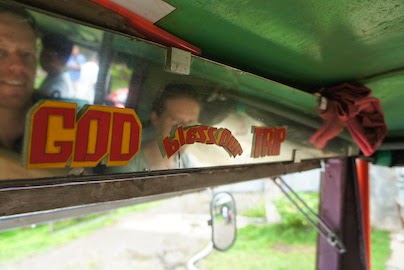
We had learnt during our short 6 week stay in the Philippines that the three B’s were the heart and soul of the people. The population was profoundly Catholic attending church, listening to Christian music, adoring their saints and covering their tricycles in biblical names like Saint James or Christobel as if they were another family member. On the jeepney trip in Palawan there was a sticker on the rear view mirror asking God to ‘Bless our trip’ (because we quickly learnt that the rear view mirror certainly had no other practical purpose). We struck up a conversation with a Filipina in Dapa and when she learnt that we were off a yacht that had come from Australia, she was praising God and blessing us all the way home again! The love of the bible and Catholicism or other Christian denominations was nationwide and added a warmness to Filipino interactions and with us interlopers.


Divine assistance was required for a safe journey!

There was an overt drinking culture, such a stark contrast to neighbouring Malaysia and Indonesia where alcohol is heavily taxed to impede consumption for countries where the national religion forbids it. The national beer brand – San Miguel cost $1 at a bar and as low as 50c from a store in small brown glass bottles that were recycled, you could almost count the years of its service by the scratch marks on the outside of the bottle (a very efficient way to manage the glass needs and drive down the cost). The brewery was another lasting legacy of the Spanish colonialism era, located in a town outside of Manilla and servicing the entire country and all of its remote islands with a beer they proudly consume as few other brands compete with its sale, certainly an easy winner for this enterprise. Next is the Philippine made rum – Tanduay where you can pick up a 1ltr bottle for $1.20, it may be a bit rough but it also cleans the fibreglass very effectively. You can look at the Philippine basketball competition to see the ‘San Miguel Tigers’ battling it out with the ‘Tanduay Lions’, such is the role of alcohol in the society that there is no regulation against advertising and sponsoring sporting competitions.

Basketball has truly been embraced by the Pinoys, a gift from the US era producing a sport loving culture that is evident in even the smallest villages. When we were in Puerta Princessa, the NBA finals were being televised from the USA and our tricycle driver was listening to the broadcast over the radio on his mobile phone, while every shop we walked into had the staff and their extended family glued to every minute of the action. The unfortunate power crash partway through the final quarter almost led the locals to riot. No matter what island or what language spoken, we saw hoops pinned to tree trunks or stuck on walls and kids through to adults almost always shooting hoops. Given the cramped and populous living conditions of the Filiponos, the joy they derived from playing basketball outside was obvious and an escape from the indoor life. Hugh was invited a couple of times to play, but often the rims were lower than his eye height, not a particularly fair match!

Spurs champion of the future? Playing with a basketball stand fashioned
out of welded pieces of metal, held down by large rocks.

So we made our way through our last legs of the trip, upon leaving Port Carmen we noticed that 120lts of fuel had been siphoned from the jerry cans locked securely to the deck. A wave of anger and bitterness came over us, we had only been in Carmen awaiting our sail repair, so we had been most unfortunate. However, we were off on a 100nm overnight sail, bound for Surigao port for an unscheduled fuel stop and our last Philippine stop. We arrived there after a brilliant overnight trip with great wind and none of the nasty fishing obstacles that we had been warned about (such as 4m long metal drums that could do some serious damage to the fibreglass if struck). Surigao port was less than inviting and the town did not have much going on. So fuel stop completed, we sailed another 35nm to the small town of Dapa in Mindanao for our last fresh food stop and to pick our weather window for the 550nm Pacific Ocean crossing to Palau. Another tropical disturbance kept us in port for 3 more days while we waited for a clearer (and larger) window. A typhoon was forming east of Guam and we needed to be confident that it would head north and west, not south and onto us! Thankfully it made its intentions clear enough and we were able to leave, though the wind was high so we prepared for high winds by tying in the third reefing line in the main and leaving bright and early in Monday morning so that we had some good visibility picking our way through the reefy sections exiting Dapa and the Philippine archipelago. Another ocean and a new world awaited us on the other side of the Philippine Sea…the Pacific better get ready, because we were on our way!


Thanks for having us Philippines

3/8/2014

Tuesday, 22 July 2014

Hunkering Down

It was not our intention to be in the Philippines during the typhoon season, it just ended up that way. At the beginning of the season the typhoons historically track more west and north, so that the Philippines is generally skirted and does not receive the full brunt of the typhoons damaging winds and pelting rain. As the season wears on, they tend to track more direct west from the Guam area and the Philippine eastern islands take the full brunt of the tropical force before the storm has crossed enough land to de-power. Having experienced the enhanced monsoon winds from distant typhoon Neoguri/ Florita at Boracay (Cat 5 - 130kt winds), we had now sat out typhoon Rammasun/ Glenda at Port Carmen (Cat 4 - 120 kt winds) and were watching as typhoon Matmo/ Henry blasted north and west of the Philippines. The El Nino year can see a rise in the development of tropical storms or typhoons in this part of the world, as the cyclic warm wind and warm surface water travelling west across the Pacific Ocean builds forming a circular moving motion with the Coriolis effect to culminate in one hell of an exciting* time to be in the region and travelling on a boat. We watch as the systems develop and build, we watch three or four weather forecast systems each day and see what the latest predictions are and whether the speed/ direction/ intensity of the systems are changing for the worse. Every day's decisions are based on those predictions and information about sheltered anchorages could the wind spin around the dial and come from a different direction as the systems move on.

*bloody scary

Grib file showing the wind and rain prediction - the darker the ticks the stronger the wind, the dark grey
patches indicate rain. This swirling pattern is typhoon Matmo/ Henry, just north and east of the Philippines
(the small green box is where we are located)
We intend to leave Surigao to make the 600nm eastward journey to Palau, crossing the Philippine trench, where the water depth plummets from 200m to 5000m. This is likely to be a point where there are strong currents, choppy and sloppy seas and we will be doing it all keeping a close eye on the tropical weather systems and whether we have to make an abrupt southward turn to get to safety.

But right now we are hunkering down as the strong wind systems blow through every day and some squally rains fall. So, what to do? It's not all sunsets and cocktails, I mean it mostly is, but somedays we have to do... chores, bread making, mould cleaning, food stock review and rotation, catching rain, clothes washing. This anchorage has a ground hog day feeling about it. The town ashore has a good fresh food market and some super tasty restaurants dishing up some chicken stews and fried chicken delights (certainly a Philippine favourite). But we don't need to get fresh food everyday. Our friends on SV Shah and SV Shanghaied abandoned us 3 days ago in search of new places and nice water for snorkelling. We had been spending most mornings luxuriating aboard Shah-bucks, enjoying some western style coffees and talking all thing politics and sailing. 

One day was taken up as we endured the epic journey to Cebu city from Port Carmen. Thankfully the sailmaker - Marlon from Hyde Sails, came to the boat to collect our shredded sail, and we caught the 1.5hr long car trip in with him to the Mactan Island tax-free industrial zone to inspect our sail and decide on its future. We had spent the previous two days desperately trying to dry it in the constant drizzle, without it getting ripped up in the rigging when the 20kt gusts blew through. We also had nowhere to lay it out, so the sail loft was going to be perfect. We arrived and walked up to the third floor of the enormous sail factory. A level dedicated to spinnakers and mainsails, a level dedicated to lasers and dingys sails and a level for canvas and shade work. If we have to draw a positive from exploding the spinnaker, it would be that we did it 30nm from one of South East Asia's prominent sail lofts with skilled expertise, modern technology and machinery (and guys who could fit us in at the last minute!). The loft was located in a special tax free zone that enables the businesses to import materials and export products free of Philippine tax and they also have a 7 year income tax exemption period. Such a significant bonus for any business. Though it does seem that a lot of manufacturing is undertaken here and the cheap labour is the driver for international production.

Hugh and Marlon inspecting the various pieces of the sail
(in the background are the huge laser cutters for racing sails)
Thankfully the guys decided that the spinnaker could live again and set to work patching and resewing the seams that had burst. Hugh showed the sail guys the rope burn the spinnaker sock had done to his hand as he had let it go just as the full 35kt wind impact hit him and started to lift him from the deck of the boat, they were very impressed! The might of the wind in a huge sail is very impressive, we were lucky nothing else broke (including Hugh)!

We left the sail loft and were overwhelmed by the amount of construction and activity going on in Cebu city. Guarded high grade condominium developments being erected right next to small shanty villages, isolated shiny malls plotted along a dusty highway with expanses of fields between the next development and guys with woks full of scalding hot oil deep frying anything you want to snack on (chicken wings, hotdogs, strange pink balls of something). Certainly a city of dichotomies, on the one hand lunch in a small bambo hut of fried chicken for 50 cents or buying a new ipad for $1000 next door. It was obvious that there was a great gap between the rich and the poor in this city. But as a result of the development, the city was a dusty, noisy and congested place. 

Our taxi driver took us to the old Fort San Pedro, which apparently has had many uses including as a prison and zoo, but now has some tasteful gardens and interesting photo gallery depicting some of the last 120 years of Philippine society. Momentously, it was here that the Spanish lowered their flag and left in 1898 to leave behind the country as they reluctantly handed it to the USA. We made the short walk inland to the Basillica Del Santo Nino (church housing the famous Philippine statue of baby Jesus - Holy Child of Cebu), where thousands of devoted Philippine Catholics flock to get a chance to see the statue (which is housed in a glass box). The church has a huge outdoor auditorium where the annual Santo de Nino festival kicks off its services on 21 April. The emotion of the people at the church was quite something, and to witness the fascination of a ceramic relic that was purported to have arrived here on Magellan's ship in 1521. Conveniently located next door to the church is the Magellan Cross, a huge timber cross which is said to house some remnants of the cross that the famous navigator and evangelist erected just before he was slain by the chief of Mactan Island, before he was able to garner full Cebu support for a Catholic Philippines (he tried to use the age-old negotiation technique of shooting the locals).

All this touristing had developed in Hugh a hunger and Maccas across the road was the winner. The appropriately named 'Magellan Macdonalds' was sporting all the latest in Macdonalds interior fitouts and I believe that that is truly what Magellan would have wanted upon his discovery and attempted colonisation of the country before his unfortunate (and unsuccessful) negotiation with Chief Lapu-Lapu. 

A quick wander around one of the malls and we were ready to make the long journey back to the boat. 2 hours in a very full bus, complete with a bloke and his fighting cock (they LOVE fighting roosters here), all we were missing was the pet goat to accompany us. We made it back to the boat and collapsed after a busy day of checking out Cebu city. Now to look at the weather prediction and see where we should hunker down next.

22/7/2014


Tuesday, 15 July 2014

The Wind, It Is Always About the Wind

Our whistle stop tour of the Philippines continues, as we sail east, this time leaving Palawan and making our way to Panay and the northern island tip of Boracay. A beautiful small island that has been completely swallowed up by tourism on steroids. A place that receives 1 million visitors per year and where you can go parasailing, sailing on a small bamboo trimaran, roll down a hill in an inflatable ball or just blitz yourself at the hundred plus beach bars that compete with each others sound system for the loudest venue.

We decided to come to Boracay to wait as typhoon Neoguri blasted its way west, some 200nm north of the Philippines. While we were well out of its path, we certainly experienced heightened monsoon winds and rain, 30kt squalls and sheets of falling rain battered the boat for the best part of 3 days. While I had a cold, I hunkered below as any trip ashore was quite an unattractive option given the big winds and chop that they developed over the sea. On day 3 the sun peeked its head out and we hung out everything to dry and stretched our arms and blinked in the light, deciding to take the dingy on the long expedition to shore. When we arrived there all we found was street after street flooded as we waded through, up to our shins in water. Business and shop owners were vainly pushing water from their premises to the street. Many shops were built at a lower level than the street, so it was a circular process of flood management. We learned later that these types of rains are not uncommon in the wet season, and this flooding happens every week for 5 months of the year. With the low season still seeing thousands of tourists visiting Boracay each week, there was little down time to manage any large infrastructure projects and the governing council did not have the political will to make it happen. Such is the case with so many desperately needed projects in the Philippines, whether it is tax syphoning, lack of political stamina or outright corruption, minor and necessary projects just do not get done. In addition to the flooding, the other obvious issue with the weather (the southwest monsoonal wind and breaking shore) was the erection of 4m high plastic walls on the west facing side of the island by restaurant owners to try and protect their attractiveness with high winds buffeting them for the next 5 months. Instead of sending patrons scurrying for cover when gusts blow bullets of sand into their eyes (and more importantly their cocktails), patrons wander around behind the huge screens looking more like zoo animals. It was a bizarre experience. 

Hugh, the prolific Boracay zoo tourist

With glee we left Boracay and headed south to visit the towns of New Washington and Kalibo managing to sail for half the day with the light winds puffing out about lunchtime. We had been traveling with Will and Trish off SV Shanghaied and we had also befriended an English sailor Andy on his boat SV Shah who had been doddling his way around the Philippines for three years. Andy was playing the role of tour guide for us, and introduced us to his Filipina friend Megs who worked for a charity group that raised funds for cleft palate surgery for Filipino children. She provided some really interesting insight into the challenges that she faces being the logistics manager for that organisation and we had long discussions about the current state of the country. After lunch with Megs and a tour of a mangrove sanctuary we took the long tricycle ride into Kalibo and visited the enormous fresh market. The museum had some interesting facts about how the island of Panay had been settled by Malaysians from Sabah and the anniversary of that arrival in the Philippines is marked with a huge fiesta in January (shame we missed that one!). The center of town was crowded with tricycles and was a busy connection point for people getting off planes and catching the boat to Boracay.

Following the wind we kept on sailing (more like motoring) around Panay and stopping in at the picturesque island of Bantayan, where we anchored just a short 3nm dingy ride from the tourist town of Santa Fe.  

The sun was beating down and showing off all the gorgeous
colours of Santa Fe when we arrived.

We wandered around town, surveying the damage that typhoon Yolanda (Haiyan) had caused in November 2013. A number of businesses were closed (never to reopen) but others had new roofs and walls. The local churches had new roofs or were undergoing complete and detailed renovation. The locals told us that the streets were comparatively bare to this time last year, as many trees were uprooted or their foliage shredded in the storm. After hiring bikes and making our way across the other side of the island we got to see that the inland part was dedicated to agriculture and chicken farming. Along the way we could see the flattened landscape and we visited several communities that were undergoing repair work and were adorned with UNHCR tents and tarpaulins. The locals had a stoic attitude about it all, every year some part of the Philippines is devastated by a natural disaster, it just depends on the location whether the same place will be damaged again. The Filipinos just pick themselves up, dust off and get back to it, such a resilient race amidst such gloom! We also visited a social housing project funded by a mainly European charity – Gawad Kalinga (GK), where dozens of houses were being built in an effort to alleviate poverty for Filipinos. The design was reminiscent of my social housing days and we all talked about how they would fare over time and whether they would become ghettos. Whatever the opinions, the people had a roof over their head and the housing development also included a farming component, so that the residents had something to do and also a way to make money/ feed their families. The most positive aspects of the development were the piped sewer and neat (and safe looking) electricity. The GK employees also talked about the education and training program that they put the budding residents through so that they understood their obligations and responsibilities in the village and home ownership and their contribution of 300 hours sweat equity.

Social housing development which had suffered damage from Yolanda,
proud homeowners give us a tour of their village
Continuing our cross-island odyssey, directly west we found the town of Bantayan a working port with an enormous fresh market (with shredded corrugated iron roofing) still bustling at 7pm on a Sunday night. After having a refreshing beer and watching the sunset, we made our way back across the island to Santa Fe. Upon arrival we found that our dingys were stranded as the spring low tide had exposed the rocky beach for hundreds of meters, we figure 2 hours ought to do it and went to find some dinner. The dingy trip home was not as pleasant as the ride in, as we were battling a rain squall with water bullets stinging our eyes as we searched for protruding reefs that would bring us unstuck. But we made it back, and of course upon arrival at our yachts, the rain stopped and the moon shone through. 


The following day we upped the anchor and to our surprise there was wind! Out comes all the canvas and we are off, making our way around the island of Cebu. There was a tropical storm on the brink of becoming a typhoon that was predicted to track west into the Philippines, so we were keen to find a cyclone hole to put the boat while it passed over. As the day wore on, we realized that we would be parting company with our friends as we made the overnight journey to Surigao, 140nm south and east. We popped the kite and were going along nicely with a light wind of 5-8kts with no seas. We gybed a few times and made our way through the Cebu shipping channel when a squall developed right behind us, as Hugh was struggling to pull the sock down to smother the kite, a 35kt gust ripped through and blasted the kite, shredding it horizontally into two pieces (but leaving Hugh on the boat thankfully). Oh dear. The boat had stopped moving and the pieces of the kite were being retrieved, the squall and its sudden downpour moved off, THANKS! This was not what we were hoping for as we would likely need our spinnaker for the 5 day leg to Palau. Conferences with our friends on the VHF and Andy the tour guide advised us of a great sail maker in Cebu. A change of course and we were headed south to Port Carmen where we would lick our wounds and take the kite the 1 hour tricycle ride into Cebu (the second largest city in the Philippines) to have repairs done. 

At 12:01 am the anchor was down and another day of adventure on the sea was finished. The wind…

15/7/14

Friday, 27 June 2014

El Nido, the Phi Phi Don of the Future?

It seems that everyone is putting their hand up for involvement in the Hollywood movie – ‘The Beach’. While it was filmed on the gorgeous Phi Phi islands of Thailand, El Nido is purported to have been the location for the writing of the book. We went to Phi Phi Don last year and it was a beach that had max-ed out its tourist industry with dozens of boat operators jostling for your custom to drive you to Phi Phi Ley to sit in a ‘secluded’ beach with hundreds of other people. The real drawcard to those islands are the stunning limestone rock formations that rise up out of the water and often enclose golden sandy beachlets that look picture perfect. El Nido has those same limestone formations and is absolutely stunning, without the horrible hectic tourist element. The town has a rough grid street pattern dominated by small shack-like single story shop fronts, the end of the streets at the east of the town has rock wall structures rising to the heavens bounding the town in. Low shrubbery clings to the sharp flat rock faces and gives the town a really enclosed and almost secretive feeling. One morning when it was raining a low band of cloud hovered over the rock peaks and eerily swirled revealing glimpses of the rockscape behind. Bars, restaurants and dive operations line the beachfront and you can stroll along going for a leisurely bar crawl, moving north along the beach to get the best sunset view as the evening rolls in.


Limestone rockfaces enclose El Nido town
We are here in the southwest monsoon which is also the wet season period. Every day, mostly in the afternoon or at night, a ripping breeze pummels the cove and gusts of 40kts send boat owners securing their washing and tying down anything loose.  Next comes the rain, not usually too much but the strong wind drives it into your face and sends you running for cover. So it is the low season for tourism, which suits us just fine. While the daily storm and rain periods are inconvenient, it means that the town is not so busy with tourists.

I made the tricycle trip to the market on Wednesday (the good day apparently). The deafening sound of pigs and goats being led off to the slaughter place (open area behind the market) was my greeting. Bright colours of fresh bananas, avocados, mangoes and oranges filled my eyes. The sight of fruit was exciting as it was not something cherished on Peninsula Malaysia and I made a beeline for the mandarins and oranges. Still the animals were screeching, and pigs can make a good scream if you just look at them funny. At least you know the meat you are buying is fresh, the sound of pigs was a stark contrast to Malaysia, where pork is forbidden. I picked up loads of potatoes, bananas, watermelon, tomato and some replacement ginger for the next batch of ginger beer (more about that later).

As we dropped anchor in the bay, who did we spot but our old friends ‘Shanghaied, Aussies who we had met in Saumlaki on the Indonesia Rally. While we had stayed with the rally for the 3 month period travelling west through Indonesia, they had left at Banda Neira and sailed north to Ambon and onto Raja Ampat, before spending the next 8 months exploring the Philippines. We invited them over to EJII along with some new friends on ‘Free Spirit’ to indulge in some boat brewed hooch - ginger beer. I made up the wort batch in Kota Kinabalu, and it had made the rough passage from Borneo and up the coast of Palawan before its taste testing in El Nido, explosion free which was an excellent outcome! To the surprise of the tasting participants “it was actually ok”, and a few more bottles were opened and shared around. Abe had predicted the brew to be somewhere between downright awful and slightly tolerable, but he was happy to throw down a few glasses!

Boat brew success! Thanks to my tasting team, Shanghaied, Free Spirit and EJII
Another gastronomical (and social) experience was when Hugh and Abe went ashore at Balalo Bay, a tiny fishing village just 40km south of El Nido with no mobile phone reception and one house with electricity (petrol generator). We were hunting for a spot to anchor and dozens of children came running out on the pier, jostling each other and jumping up and down whooping and hollering while waving. They sure were excited to have visitors. With ideas of a fish curry for dinner, the boys went ashore, to be mobbed by all these children. Falling back to our old faithful ‘cross cultural-win’ with children, the high five, Hugh and Abe made themselves very popular with the kids. Hugh is 1.98m tall so when he puts his hands up at his shoulders, they are high off the ground. Filipinos are not a tall race, but the enthusiasm by some kids to high-five Hugh led to much jumping and super-human strength! Such fun kids. 


Enthusiastic High-Fiving!
Eventually Hugh and Abe were able to ask where they could buy fish, and like the pied piper leading the children, they made their way through the village with dozens of kids all pushing to be closest to them, to the man with the fish. Some negotiating done, three small fish were purchased and it was two thumbs up for fish curry for dinner. Abe passed on some exercise books and pens as gifts for the kids, hopefully they will find them useful, and they made their way back to the boat.  It was such a contrast to see this remote village, cut off from other parts of Palawan as there was no serious road access. It was so close to other places that were tourist hot spots, El Nido even has an airport, yet they lived a completely different life. We wondered whether mobile coverage would extend to this location and how long this village would remain in its isolation.


After 6 days at El Nido we decided to move on. We had had a fun time eating ashore, enjoying the edible delights of Adobo (meat stew with potatoes) and diving the beautiful waters. This sure was a nice place to visit and I hope that it does not become as over populated as Phi Phi Don, because that place was real tourism overload! A teary goodbye to Abe-l Seaman Abe (we're not above a cheap pun on this boat), as he left to fly out from Puerto Princessa and we continued our whistle stop tour of the Philippines.

27/6/2014

Friday, 20 June 2014

The Balabac Strait

A crossing that reminded us of the nasty beam swell and uncomfortable seas like the Gulf of Carpentaria and the Arafura Sea. The Balabac Strait bridges the waters between the Sulu and South China Seas, a veritable spin cycle. Abe went to sleep and dreamt that he was in a washing machine with jeans and a belt...the sensation was that close, except without being smacked in the head with a belt buckle. 


Swirling sea, nightime snap off the aft deck
The boat wanted to heel to starboard, but the 3m enthusiastic swell coming at us from the port side was not going to play nice. So began 3 days and 2 nights of an extremely uncomfortable trip making our way from Kudat in northern Borneo to Ulungan Bay on the western side of the Philippine Island of Palawan. You may recall that we were planning a different route east over the top of Borneo, however our plans changed dramatically, but you'll just have to read our next instalment to get the full story on that one.

The southwest monsoon had finally decided to turn up this year, better late than never! It brought a constant 15-20 kt wind and swell with it for the ride. With squalls bringing torrents of rain and 40kt wind gales, we were in for a not so fun passage, though Abe was in for a treat as we 'hove to' waiting one storm out (thankfully it was a short one). 'Hoving to' is a maneuver turning the boat into the wind, dropping the sails and waiting for the storm to pass, some boats have stayed in that position for days at sea waiting for a system to pass through. A break in the rain showed off the stunning and rugged coastline, tall sharp cliff faces with low shrubbery, very different to the jungle clad Borneo coast and lots of steep mountainous terrain. It was with much relief that we turned into Ulungan Bay, so flat and calm that we could finally put the 2 minute noodles away and cook some real food, roasted vegetable pasta it was!

After a good sleep Hugh and I Ieft Abe as boat sitter the next day, and went on the 50km over-island journey to Puerto Princessa (PP), the bustling city of the island and home to some 6000 tricycle cabs (motor bike with a metal buggy and roof structure which could comfortably carry 4 passengers, but could certainly fit 6 judging by the locals!) But first we had to get to town, via the 3 hour jeepney trip. A jeepney's distant cousin was the land rover, maintaining the bonnet and axle design, but with a 30 passenger bench seat capacity thrown in behind the driver and 1 tonne strength roof (for carrying 30kg bags of rice, 30ltr blocks of ice, slabs of soft drink, fuel containers, meat and vegetables). Oh, and adorned with rainbow colours, religious paraphernalia and tinsel, nice! The jeepney driver turned out to be the postman, the payer of bills on behalf of the rural villagers, the corner store delivery guy and the guy who gets your fuel cans filled. He also has a team of able young men carrying all these items up and down from the bus and acting as the reverse sensors with a loud 'tap tap' on the roof of the bus. The trip was long and slow, but it was great to see some of the island hinterland and see how amiably the locals got on with each other, a real community spirit and thoughtfulness.


Bright Jeepneys being loaded up for the homeward bound journey
The town was busy, with tricycle cabs zooming along and squeezing into unsqueezable spots. The immigration office was our first stop, to get our all important 'country arrival' stamp and then down to the customs office to check the boat in. Thankfully our tricycle cab driver was in the know and the drive across town to the far flung offices. The lady at the customs office was great and was helping us learn some Tagalog, she also helped us by identifying which words are the same in Spanish as Tagalog. She spoke almost perfect english and it turns out that three decades of US colonialism is still evident in their education system today and many Filipinos speak excellent english, which is a real bonus for us.

Indulging in some barbequed chicken for lunch (with unlimited rice, as is the selling point here in PP), picking up some donuts for Abe and some more fresh veggies and we were back at the bus station, ready to catch our jeepney home. It had been raining while we were doing our admin chores, but that wasnt cause enough for the driver to lower the front windscreen from its open horizontal position as we sat in the front seat, back on went the sunnies to prevent dirt and insects from lodging themselves in our eyes. Well it was a whirlwind tour of PP with highlights being the immigration and customs office, experiencing a new country and its checking in procedures, travelling by boat is always a different tourist experience. 

20/6/2014


Tuesday, 10 June 2014

Covering off Sabah

Kudat, a strange yet very welcoming place. The former capital of the Borneo state of Sabah, now a town that seems to be lost in another time. Shop houses with timber second stories, footpaths that are used for walking on (not parking scooters or stacking shop wares) and cheery locals that grin at Hugh and shout "hello, hello mister, I love you" before giggling. The man that stopped us in the street to show us the large glass ball that he was holding is his mouth was strange indeed, but funny nonetheless. It seems that tourists from western countries do not visit here much and the locals are stoked to get a chance to practise their English skills.

Kudat main street, neat two-storey shop houses and landscaped median strip
We had spent a few days making our way north after quickly popping in to Kota Kinabalu (KK) - a busy and vibrant tourist town (also the current capital of Sabah). While it is a brilliant city to visit, it is a nightmare of a place to take your boat with no good anchorages in the current south-west monsoon and the single resort marina is slowly becoming more and more member focused, charging an outrageous amount for the simple luxury of using their dingy dock. So it was a quick provisioning stop to top up on cheese and other western delights, some fresh food from the market, oh and collecting our friend Abe who would be joining us for a couple of weeks aboard and we were off again.

On our way out of town, we were busy looking for a fuel barge that we had heard was anchored in the strait between KK and Pulau Gaya. We were following the channel markers and thought we could spot it, but we were not sure so we were asking off the bow of the boat to locals coming past if it was...they just smiled and waved...lost on translation I think. As we were in a precariously shallow part of the channel, we saw it and just came up beside throwing ropes and fenders over the side to secure us in. It was located in a particularly highly trafficked area, but we just had to tie on the best we could and hold on when the wake came crashing through. Seeing the fuel attendant smoking a cigarette next to the 'no open flames' sign, ready to create a floating bomb was just par for the course. The fuel pump was set for super yachts and fishing boats that use hundreds of litres an hour, so Hugh had fun trying to slow the flow for our comparatively meagre tank without sloshing it all overboard, making for another fun refuelling adventure.

All fuelled up we anchored on the northern side of Pulau Gaya, with a picturesque view of the jungle covered hill. There was a small family development nearby who took their canoes out fishing with nets in the evening. We followed their lead, though we had no luck with our fishing attempts, so had to settle for veggie stir fry instead.

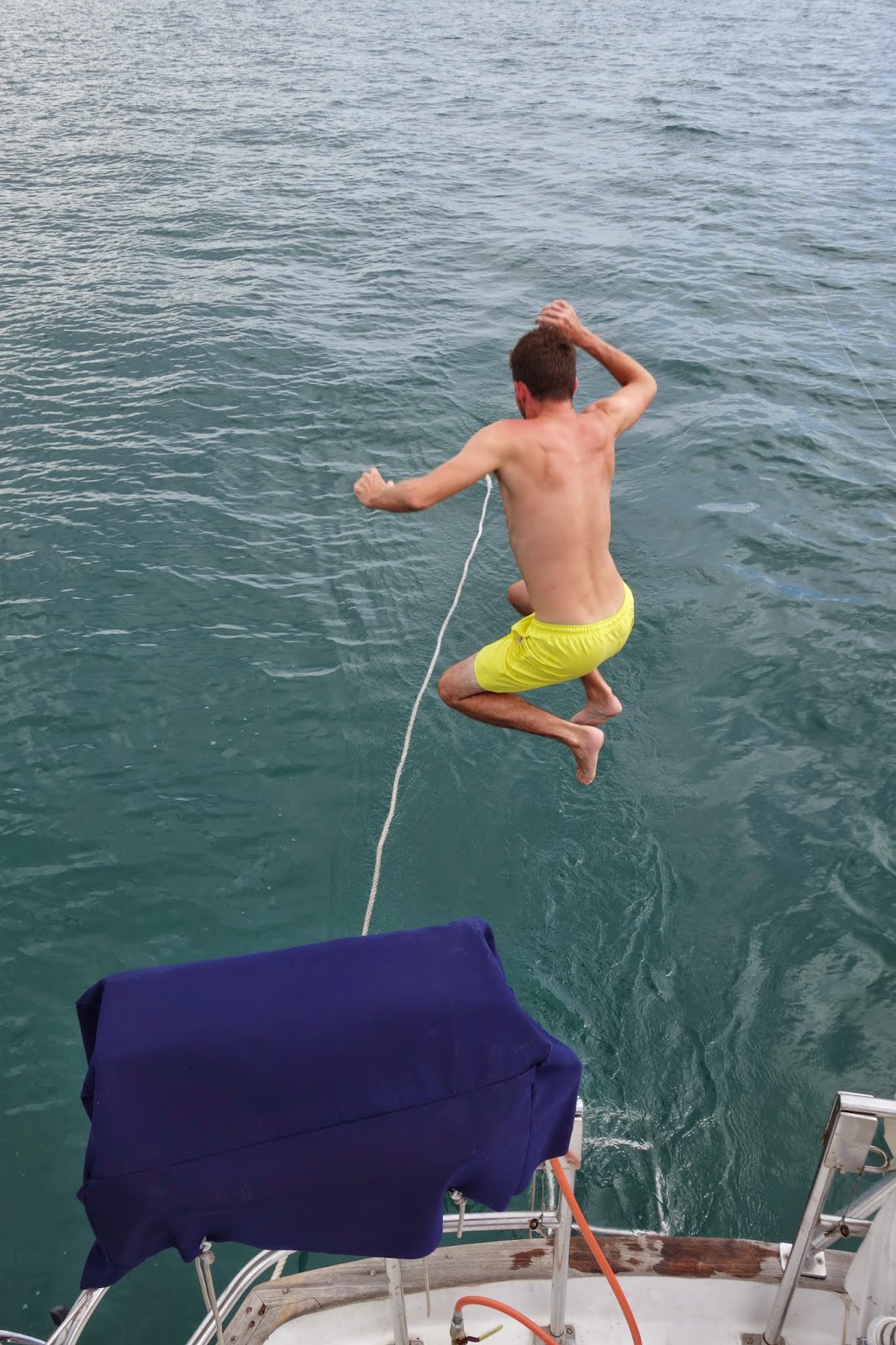
A few days of uneventful sailing and motoring and we arrived in Kudat. Possibly the hottest place we have been to yet, though the afternoon storms do something to quell the searing daytime heat, the subsequent mozzies that come after it are less fun. Diving off the boat for a quick dip while we were underway helped manage our overheating en route. 

Abe taking a refreshing mid-sail swim
Kudat has an interesting history, stories about it being abandoned as the capital of Sabah varied depending on the source with tourist brochures referring to the British relocation of the capital due to the inability to secure a fresh water source, others refer to the repeated sacking of the town by neighbouring Filipinos. The town was then forgotten by authorities and remained remote, with the first road being constructed connecting it to KK in the 1970s enabling the old town to retain its charm and constrained its development or role as a trading port. A brilliant fresh food market makes it a great provisioning port for us. We were treated to some amazing hospitality by the marina managers, who took us out for lunch to gorge on some local Chinese delights and also to the local chamber of commerce to get a 'permission' letter to buy extra fuel (ie, more than 20lts), which made our time here fun and always interesting.


Our hosts - local city Councillor Johnie and his son John
Having seen the main attraction on our way past (the northern most point of Malaysia), we had little else to do here. Impatiently awaiting our package of rope for our furler posted from Australia (which may have been lost in the bowels of the Malaysian postal system) and watching our new 12v to 240v power inverter blow up were just other fun things that remind you why not everyone is out here sailing.


Happy Captain, package success!
10/6/2014